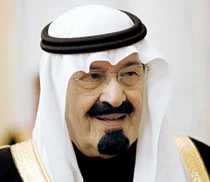
JEDDAH: The Council of Ministers yesterday commended Custodian of the Two Holy Mosques King Abdullah’s futuristic vision that aims to achieve a balanced development for all the Kingdom’s regions, boost relations with friendly countries, promote interfaith dialogue and crush terrorists.
In a statement on the occasion of the third anniversary of King Abdullah’s accession to the throne, the Cabinet underscored the king’s tremendous achievements at national and international levels.
Abdullah became the king on Aug. 1, 2005 following the death of King Fahd.
King Abdullah, who presided over the Cabinet meeting at Al-Salam Palace here, said Saudi Arabia would continue its efforts to strengthen its relations with other countries to achieve Arab unity and for the success of Islamic causes.
“The king’s vision affirms the Kingdom’s commitment to Islam as a faith, law, identity and a system,” the Cabinet said.
It also noted the king’s plan to make use of the budget surplus created by oil revenues to carry out welfare and infrastructure projects throughout the Kingdom. Acquisition of foreign technology, modernization of the education system, opening of new universities in all the Kingdom’s regions, increasing the number of scholarships for Saudi students to study abroad and introduction of e-government are the thrusts of the king’s vision.
The Cabinet also praised the launch of the SR10 billion King Abdullah University of Science and Technology (KAUST) in Thuwal, 80 km north of Jeddah. KAUST is being developed as an international, graduate-level research university dedicated to inspiring a new age of scientific achievement in the Kingdom.
During the last three years, King Abdullah has focused on providing a decent standard of living for all groups of people in the Kingdom by increasing the capital of lending organizations and the allocation of social insurance, and implementing a project to construct low-cost housing for the poor.
King Abdullah wants more investments in energy, petrochemical, mineral and tourism sectors and to improve facilities for the welfare of pilgrims who come for Haj and Umrah, the Saudi Press Agency said, quoting a Cabinet statement.
“The king also worked for the settlement of inter-Arab disputes. The extraordinary Islamic summit in Makkah called by the king resulted in the issuance of a 10-point action plan.
The king also called for an interfaith dialogue... to promote peace, love and morality and bridge the gap between countries and societies,” the statement said.
The Cabinet urged the government departments, social institutions and media organizations to promote the king’s vision at national as well as Arab and Islamic levels.
Culture and Information Minister Iyad Madani said the Cabinet took a number of important decisions.
The ministers approved an agreement with China on civil aviation. The accord allows the operation of one or more airlines on routes agreed upon and that both parties should ensure the smooth operation of the other party’s airline.
Referring to participation of government agencies in the Haj operation, the Cabinet said each government agency should prepare its Haj service plan in coordination with other agencies and present it to Interior Minister Prince Naif, who is chairman of the Supreme Haj Committee.
The Cabinet also approved three new insurance companies — Wiqaya Takaful Insurance Company, Al-Rajhi Cooperative Insurance and AXA Cooperative Insurance.
The meeting reviewed the progress of 1,096 road and flood control projects in various parts of the Kingdom.