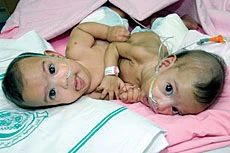
RIYADH: Custodian of the Two Holy Mosques King Abdullah has issued directives for surgery to separate Moroccan conjoined twins, Safa and Marwa, at King Abdulaziz Medical City (KAMC) here tomorrow.
The king will bear all expenses of the surgery, said Dr. Abdullah Al-Rabeeah, head of National Guard Health Affairs who will lead the multidisciplinary medical team that will perform the separation.
The twins were brought to Riyadh Air Base on April 4 my Medevac under the directive of the king. “Preliminary me-dical investigations were carried out yesterday by the surgical team,” said Al-Rabeeah.
The twins have a conjoined lower body and they are also diagnosed with congenital heart problems, said Al-Rabeeah, adding that the twins are currently in stable condition. He said doctors have decided that separation is the best choice for the girls’ future.
Another set of Moroccan conjoined twins, Hafsah and Elham, were separated successfully at KAMC on March 4, 2006.
Al-Rabeeah’s team has so far performed 13 procedures for the separation of conjoined twins since 1990. Three sets were from the Kingdom, two each from Sudan and Egypt, and one each from Malaysia, the Philippines, Morroco, Iraq, Poland and Cameroon. All the operations were successful.
Al-Rabeeah performed the first conjoined twin separation operation in the Kingdom on Dec. 31, 1990, at Riyadh’s King Faisal Specialist Hospital. The operation, which was successful, was performed on Saudi female twins joined at the stomach.
Referring to the challenge faced by the multidisciplinary team, Al-Rabeeah said, “The team has met on several occasions to review the status of the twins and decided at the last meeting to perform the separation although there is a 40 percent risk due to the condition of Marwa’s heart; she has severe congenital heart disease.”
The investigations have shown that the twins are joined at the lower chest and abdomen and share a liver and maybe part of the bowels. “We all pray for the wellbeing of the twins,” said Al-Rabeeah, adding that the operation is expected to last about 10 hours.
All preparations have been made for the procedure that would start at 7 a.m., he said.
A set of Iraqi conjoined twins, who are under observation, are now awaiting separation surgery at the medical city.
Conjoined twins occur roughly once in every 50,000 births worldwide, but only a few survive.