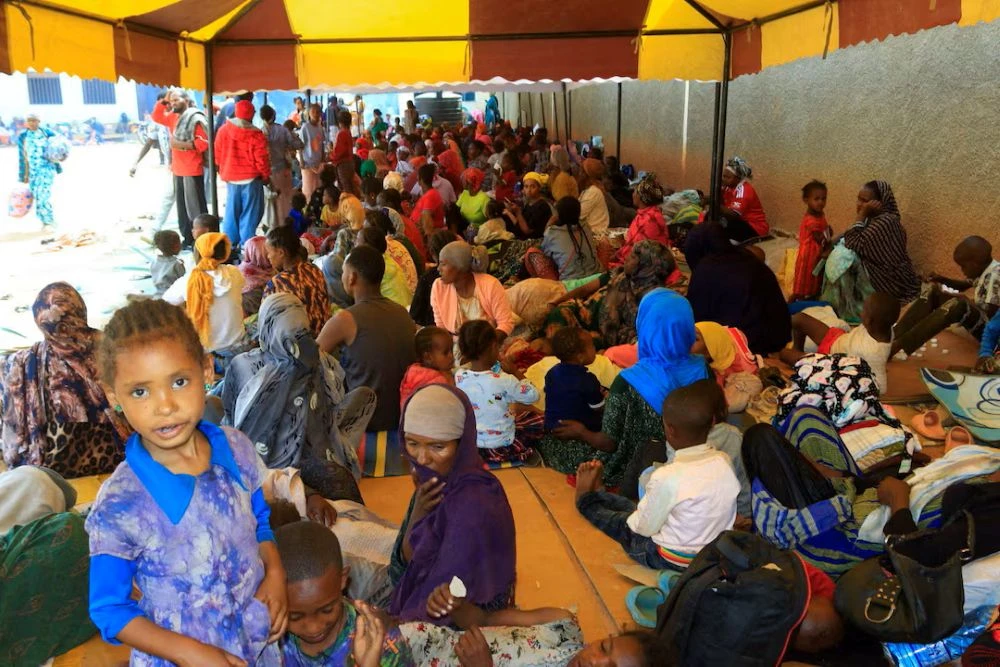
WASHINGTON: With the third-largest Arab population in the US, Michigan became a popular resettlement location for Iraqi refugees. Now, many refugees who arrived here say they were unable to navigate the system, and make this country their home. It is one of many unintended consequences of the Iraq War, now in its sixth year.
Of the two million Iraqi refugees outside their country — another two million are displaced within Iraq — only about 10 percent register with the United Nations High Commissioner for Refugees (UNHCR) to apply for resettlement.
Of that group, only about 10 percent qualify for relocation.The US pledged to receive more refugees than any other nation. Despite an initial promise to resettle 7,000 Iraqi refugees in the US, the US was slow to emigrate them.
The refugee-processing system wasn’t able to handle all the requests, an official of the State Department’s Bureau of Population, Refugees, and Migration (PRM), told reporters. The Bush Administration also faced much criticism for taking just a fraction of the massive wave of refugees caused by the Iraq war and years of sectarian violence.
“They (the Bush administration) have basically tried to do as little as possible,” said Jake Kurtzer, congressional advocate for Refugees International, a Washington-based advocacy organization. Two years ago, only 202 Iraqi refugees were allowed into the country. This year, that number is almost 14,000 — and most refugees have gravitated to Detroit, home to America’s largest Arab population as well as a sizable Iraqi Christian or Chaldean community. But now officials say they’re swamped. For Iraqi refugees who make it to the US, the American dream is often not what they hoped.
While it’s meant safety and often better pay for low-income refugees, it has proven to be unacceptable for many well-paid Iraqis, at least so far. Language barriers and a job market seemingly limited to menial jobs are major frustrations.
A disappointing welcome for those who dreamed that coming to American would end their nightmares. Just getting to the US was not easy for Iraqis. Most of the refugees left after receiving threats from insurgents, others lost members of their families. The majority spent at least a year, usually closer to two or three, living in Syria or Jordan where they were not permitted to work. Many used the bulk of their savings while living there.
Once in the US, for example, refugees must over time reimburse the US government for the cost of their plane ticket, usually well in excess of $1,000. Though some are given small stipends, they lament that they start life in the US already in debt. In the US, many new arrivals say life hasn’t improved much. Many subsist on food stamps, housing supplied by refugee services, and get whatever medical care they need from Medicaid. “As they move to this country, sometimes expectations may not exactly match the reality here,” says Joseph Roberson, director of Church World Service’s Immigration and Refugee Program. And that’s the officials’ main worry. The immediate resettlement - finding a house, giving three months’ worth of cash assistance - is the easy part.
The hard part comes afterward, when the money has run out, the economy is still bad and affordable housing is hard to come by. These refugees will have to deal with that in the long run. In addition, America’s car industry crisis has resulted in major layoffs in the area, which makes Michigan has one of the highest unemployment rates in the country.
The last thing the state needs is more people coming in without jobs — including refugees from Iraq.
The economy is now so bleak that the State Department no longer wants to allow Iraqis to settle in Michigan unless they have immediate relatives already living there.
One Iraqi recently told reporters that the economic prospects in Lansing, where he settled in Michigan, offered little hope. “We face some difficulty in the US,” he says. “They brought us to a cold state, and this state has the highest unemployment rate in the US,” 7.4 percent as of November.
In Lansing, many of the Iraqis say the only work available pays $7 an hour and requires manual labor. Those wages are not enough to support refugees with families, they say.
While PRM helps with initial arrangements, refugee-service groups like Church World Services contract with the government and provide social services, such as employment counseling, for new arrivals. The groups say their goal is to make refugees self-sufficient within 180 days of their arrival.
Several Iraqi immigrants told reporters that will not consider returning to Iraq. Unable to find a job in Lansing, they’ve applied to work as an Iraqi villager at a military training centers in California that prepares US troops before they deploy to Iraq, by running them through mock Iraqi villages complete with authentic locals.