ARAFAT AIRFIELD: One of the main reasons that the number of illegal pilgrims has been reduced considerably this year is that the Royal Saudi Air Force is keeping a 24-hour surveillance on all the roads that lead to the holy sites, said a top Saudi Air Force official.
“During the course of our air surveillance we keep vigil on the movement of people who smuggle illegal pilgrims inside the holy sites for Haj. The moment we notice any such activity we inform our ground support personnel who immediately intercept them and thwart their attempt,” said Lt. Cmdr. Saeed Ali Al-Zahrani, the man in charge of the air operation at Arafat Airfield of King Fahd Air Base.
He declined to give any numbers about such intercepts but stressed that they have effectively curbed the movement of human traffickers.
He said that though the Haj operation was not their primary job, they take it up with utmost care and sincerity to ensure that no untoward incident takes place during the pilgrimage. The Royal Saudi Air Force has been taking part in Haj management for the past 35 years, he said.
“As far as our commitment and dedication to Haj service is concerned let me tell you that all our officers are always keen to be assigned to this job. Everybody wants to serve the guests of Allah. And it is this feeling that helps us in providing best service to pilgrims,” Al-Zahrani said.
Giving details of the operation, Al-Zahrani, who has been looking after the operation since 2001, said the preparation starts much before the Haj season.
“The preparation for the Haj operation starts seven month in advance but we start flying regular sorties from the 1st of Dul Hijjah to take stock of the security and other situation in order to ensure that everything is in place,” he said.
Though Al-Zahrani did not give us the number of choppers used in the Haj operation, five copters were seen flying at regular intervals from the air base.
“The information we have received about Haj this year has given us ample reasons to celebrate and heave a sigh of relief since this year's Haj is supposed to be the best ever. All the pilgrims were on the plains of Arafat by 10 a.m.,” Al-Zahrani said, adding that his men work in close coordination with other Haj-related departments and ministries, like the ministries of health, Haj and culture and information. He said that their operation area stretches from Mishayar, starting from Arafat, Jabal Al-Rahmah, Muzdalifah, Mina and the Haram.
“We keep a constant watch on pilgrims’ movement from Makkah to Mina then their trek to Arafat and back. When we spot congestion in any street we pass on the information to ground personnel, who take immediate necessary steps to avoid any unpleasant incident. The air force’s fully equipped air ambulance is also available 24 hours a day to provide immediate medical care to ailing pilgrims and to respond to any eventualities. There is a specialist doctor in attendance. The air ambulance is the first of its type fitted with most sophisticated equipments,” said Al-Zahrani.
Another official, Sultan Al-Bughmi, said that they provide full security to the place round the clock and make sure that no unwanted elements are allowed to visit the place.
A helicopter of the Royal Saudi Air Force took Arab News on a survey of Arafat, its surrounding areas, Mina and finally we flew over the Holy Haram in Makkah.
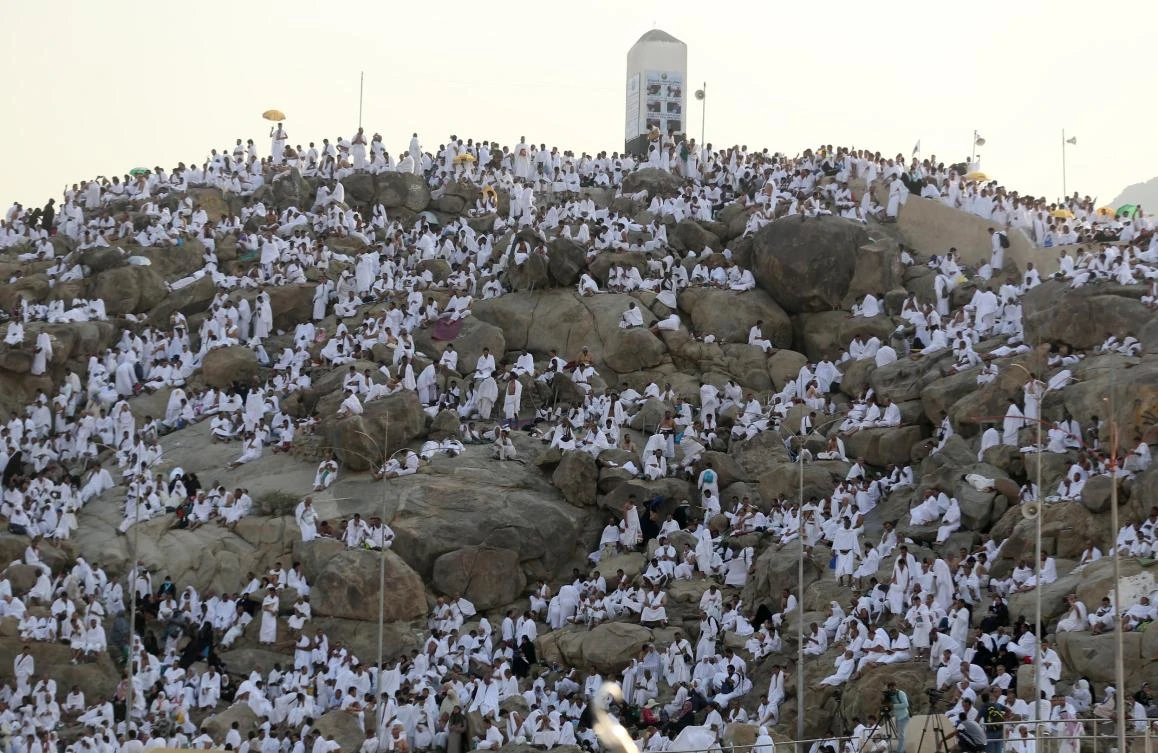
Capt. Haris, the Air Force pilot in command of the helicopter, took us first to Arafat, which, at first glance, looked like a huge white blanket that had covered the whole of the area. The sight of the faithful moving toward Mount Arafat looked as though a river of milk was passing through the plains of Arafat.
The place where Prophet Muhammad (peace be upon him) had delivered his last sermon was dotted with pilgrims. After flying for about 30 minutes over Arafat, the helicopter took us to Mina — the tent city that was abuzz with activity a day earlier wore a deserted look yesterday.
The roads, the intersections, the parking areas were all empty. The Jamrat complex appeared as a huge modern concrete structure with several towers. All its passages were clearly visible from the air.
The helicopter then turned toward the final destination — the Holy Haram. It flew low to provide a clearer view of the Kaaba.