MAKKAH: The fourth phase of construction at the Jamrat Bridge in Mina began as soon as pilgrims left the holy site after the annual Haj. As the mega project requires a large number of foreign workers, construction companies employ overstayers, mainly Yemenis who work for low wages, something that has led to the nicknaming of the area “The Yemeni Farm.”
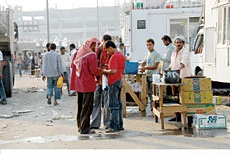
Apart from construction workers, many Yemeni traders flock to the area to sell basic commodities. As a result, one of the bridges in Mina has been turned into a big market with peddlers selling old clothes and shoes in different sizes and colors. Others sell Yemeni delicacies in makeshift stalls made from wood salvaged from the construction project.
Some sell mobile phones, stolen and legitimate, and prepaid phone cards, while others openly peddle cigarettes in spite of a smoking ban in Makkah.
Abu Al-Qasim, a Yemeni overstayer, told Arab News that he used to live in mountains surrounding the Jabal Al-Nour area of the holy city. “I didn’t have any work or any source of income. About a year ago I met a fellow Yemeni who advised me to go to Mina where I could live and work,” said Abu Al-Qasim.
“I’ve been living comfortably in Mina ever since and making some decent money,” he said, adding that in Mina he met a relative whom he had not seen for 20 years because of a family dispute. “We’ve reconciled and are now peacefully sharing accommodation,” he said.
Asked how he avoids Passport Department raids, Abu Al-Qasim said, “Whenever there is a raid I hide in the mountains around Mina and wait there until they go away.”
Naji Hassan, a young Yemeni, said he worked in the development projects for nine months during which he was able to save about SR2,500. “I used the money to open a small café selling breakfasts to workers. The business flourished and I also serve lunch now,” he said.
Hassan said he uses planks of wood obtained from the project to make tables and signed a contract with a bakery in Makkah to supply him with 2,000 pieces of bread costing SR250 everyday. “The restaurant did not cost me much because I did not have to do any décor or obtain licenses. I’m making a lot of money out of this business,” he said.
Ahmed Naji, another Yemeni overstayer, said he asked one of his countrymen to supply him with cigarettes, which he sells to foreigners for one riyal above the normal price. “I’m now making a profit of SR50 to SR80 a day,” he said.
Col. Ayedh Al-Lukmani, director of the Passport Department in Makkah, said the department usually concentrates on areaswhere overstayers gather, including Mina. “We’ve caught and deported a number of overstayers,” he said.
Al-Lukmani said although overstayers usually hide in the mountains when raids take place, the Passport Department will continue to look for them and deport them.