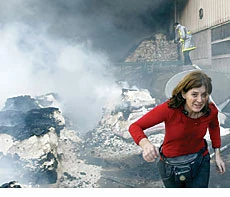
GAZA CITY: Israel shelled the United Nations headquarters in the Gaza Strip yesterday and killed senior Hamas leader Said Siam. Hamas Interior Minister Siam, his son and his brother died in an Israeli airstrike on the house of Siam’s brother north of Gaza City, Hamas television said. Siam created the Executive Force, a militia that played a key role in Hamas’ takeover of Gaza in June 2007.
Israeli forces also bombed a hospital crowded with scores of injured refugees and a high-rise building housing media outlets.
Venezuela broke off diplomatic relations with Israel to protest the killings in Gaza. The decision by President Hugo Chavez’s government came about a week after it expelled the Israeli ambassador in Caracas, Shlomo Cohen, and seven embassy staff members to protest the Jewish state’s actions.
On Wednesday, Chavez’s close ally, Bolivian President Evo Morales, announced his country was cutting off ties with Israel over the offensive.
Tons of food and humanitarian supplies intended for Palestinian refugees went up in flames after the Israeli shelling of the UN compound in the Gaza Strip. UN Secretary-General Ban Ki-moon, who is in the region to help arrange a cease-fire, demanded a “full explanation” and said the Israeli Defense Minister Ehud Barak told him there had been a “grave mistake.”
Hours later, Israeli Prime Minister Ehud Olmert said the military fired artillery shells at the UN compound after Hamas fighters opened fire from the location. A UN official who was at the scene when the compound was shelled dismissed Olmert’s assertion as “nonsense.” Three people were injured at the UN compound.
At the United Nations, humanitarian affairs chief John Holmes said the compound was apparently hit by white-phosphorus shells. “The main warehouse was badly damaged by what appeared to be white-phosphorus shells,” Holmes told reporters. “Those on the ground don’t have any doubt that’s what they were. If you were looking for confirmation, that looks like it to me.”
Terrified Gaza civilians scuttled for any shelter they could find yesterday as Israeli tanks barreled into the heart of a residential neighborhood in Gaza City. Some of them took shelter with their children in Al-Quds Hospital at dawn. Shortly afterward, part of the hospital caught fire after an Israeli strike. The blaze was brought under control in the medical area but not in the administrative building.
The attack put about 100 patients and medical staff at risk, according to the international Red Cross, while a doctor inside said many of them were trapped. “The Israelis are bombing and attacking all around the hospital. We can’t get out. There’s fire, and we’re trapped inside. The water has been cut off,” Dr. Regis Garrigue said by telephone from the building.
The incident was condemned by ICRC President Jakob Kellenberger, who was wrapping up a three-day visit to the occupied territories, including another hospital in the Gaza Strip, and to Israel. “It is unacceptable that wounded people receiving treatment in hospitals are put at risk,” said Kellenberger.
In all, at least 70 people were killed in Gaza yesterday, medics said, bringing the death toll since Israel unleashed its war machine on the Gazans on Dec. 27 to at least 1,073 — 355 of them children. Another 5,000 people have been wounded.
The UN General Assembly yesterday kicked off an emergency session with its president accusing Israel of violating international law by pressing on with its murderous assault. The Israeli delegate sought to block the session on procedural grounds by arguing that under the UN Charter, the 192-member assembly cannot inject itself on a matter already being tackled by the powerful Security Council. But the Israeli complaint was dismissed by the assembly president, Nicaragua’s Miguel d’Escoto Brockmann.
Diplomatic sources said Israeli leaders were studying Hamas’ terms for a truce. They included a yearlong, renewable cease-fire, the withdrawal of all Israeli forces within 5 to 7 days, and the immediate opening of all Gaza border crossings, backed by international guarantees they would stay open.
— With input from agencies