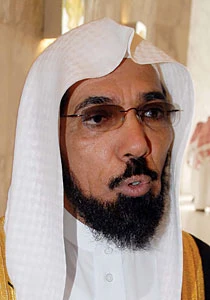
MAKKAH: Prominent Saudi scholar Sheikh Salman Al-Oudah said yesterday that fatwas were not the sole guideline for Muslim societies, and factors such as the media and cultural pressures influence their thinking and action.
“The fatwa should work side by side with the leaders of thought, politics and media in complete harmony for the creation of a better society,” he said.
Al-Oudah was speaking to Arab News on the sidelines of an international conference on fatwa and its regulations that began in Makkah on Saturday evening. Makkah Gov. Prince Khaled Al-Faisal opened the conference on behalf of Custodian of the Two Holy Mosques King Abdullah.
More than 170 scholars from various parts of the world are attending the five-day gathering organized by the Fiqh Academy of the Makkah-based Muslim World League (MWL).
Al-Oudah called for similar annual gatherings to deal with new issues in medicine, media, economy and other fields. “Through collective brainstorming, consultations and exchanges of ideas we can reach unified Islamic views on every new issue,” he said.
Al-Oudah described the Makkah conference as a new addition in the search for correct fatwas and described it as a forum where participants of different cultural backgrounds can exchange ideas.
He said the conference would attempt to lay down regulations to govern the issuance of fatwa. He, however, added that neither the conference nor Ifta bodies have the power to impose fatwas, especially in view of the information revolution. “If we are able to provide correct fatwas on satellite channels and Internet sites, and in mosques and publications we will be doing the Ummah a great service,” he said.
Al-Oudah asked scholars to carry out research to come up with identical rulings on controversial issues. He also asked the conference to issue a fatwa on the current situation in Gaza and said this was the issue of the hour and that people were looking to the ulema for guidance.
Participants in yesterday’s sessions discussed a number of issues that included collective Ijtihad (interpretation) and its importance in dealing with contemporary issues, fabrication and its meaning in Islamic jurisprudence, the significance of fatwas for Muslim societies, and changing fatwas to suit contemporary needs.
Participants were unanimous in their view that issuing correct fatwas was an Islamic duty on scholars and that this should be done within the moderate tenets of Islam. They also said that fatwas should keep pace with changes in all walks of life.