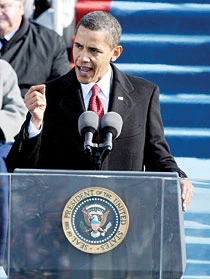
WASHINGTON: Barack Hussein Obama was sworn in as the 44th president of the United States yesterday, becoming the first African-American to hold America’s highest office and the first person of color to lead any major industrialized democracy.
Obama, 47, the son of a white Kansas-born mother and a black Kenyan father, took the oath of office in a historic and powerfully symbolic inauguration ceremony on the West Front of the US Capitol before a 3-km stretch of an estimated 1.2 million people that jammed the National Mall on a clear but cold Washington day. Obama’s inaugural address, famous even before he uttered a word because of his place in history, was both a call to action to Americans in tough times and an appeal to traditional American values.
He spoke of the nation’s long struggle to live up to its ideals of justice, opportunity and community.
Standing on the steps of the Capitol, Obama noted that “a man whose father less than 60 years ago might not have been served at a local restaurant can now stand before you to take a most sacred oath.”
Though he said he was “mindful of the sacrifices borne by our ancestors,” Obama did not dwell on race but spoke of the colorful tapestry of “a nation of Christians and Muslims, Jews and Hindus — and nonbelievers. We are shaped by every language and culture, drawn from every end of this earth.”
Obama also sent an immediate message to the rest of the world, and Muslim nations in particular, after America’s ties with some of its top allies were tarnished during the Bush years, especially over the Iraq War.
“America is a friend of each nation and every man, woman, and child who seeks a future of peace and dignity, and that we are ready to lead once more,” he said.
“To the Muslim world, we seek a new way forward, based on mutual interest and mutual respect ... To those leaders around the globe who seek to sow conflict, or blame their society’s ills on the West — know that your people will judge you on what you can build, not what you destroy.”
Obama, one of the nation’s youngest chief executives, must now deal with some of the most daunting challenges that any new president has faced in many years. The economy is in crisis; millions of Americans are out of work or fear they will be; many are losing their homes; there are wars in Iraq and Afghanistan; a global threat still exists from terrorists; and the nation is deeply worried about its future.
His most important legislative goal is to win congressional passage of a massive economic recovery package that could cost more than $1 trillion when all the bargaining is done.
“The state of the economy calls for action, bold and swift, and we will act — not only to create new jobs but to lay a new foundation for growth,” Obama said. “We will build the roads and bridges, the electric grids and digital lines that feed our commerce and bind us together. We will restore science to its rightful place, and wield technology’s wonders to raise healthcare’s quality and lower its cost. We will harness the sun and the winds and the soil to fuel our cars and run our factories. And we will transform our schools and colleges and universities to meet the demands of a new age. All this we can do. And all this we will do.”
Soon after being sworn in, Obama enjoyed his first presidential lunch hosted by the Joint Congressional Committee on Inaugural Ceremonies at the historic Statuary Hall at the US Capitol. Approximately 200 guests including the new president, vice president, members of their families, the Supreme Court and Cabinet designees, and members of congressional leadership were present. Sen. Ted Kennedy, who is suffering from a terminal brain tumor, was taken out of the luncheon on a stretcher. No further news was available as Arab News went to press.
Since 1953, the president and vice president have been guests of honor at a luncheon held by the Unite States Congress immediately following the inaugural ceremony. Other than the State of the Union addresses — and state funerals — it is the only time the president, vice president, and both houses of Congress gather in the same location.
Following the luncheon, the presidential inauguration parade brought the new president from the steps of the Capitol to the White House. Open to the public, the parade is an American tradition honoring the newly sworn in president and vice president, and included a procession of ceremonial military regiments, marching bands and floats.
Moments after Obama took the oath of office, the website for the White House, www.whitehouse.gov, underwent a dramatic metamorphosis, offering a new blog for online readers.
The new website will serve as a place for the most technology-savvy president in US history and his new administration “to connect with the rest of the nation and the world,” Macon Phillips, director of new media for the White House, said on the site.
Not to be overlooked was the importance of the day’s dress. First lady Michelle Obama wore a sparkling yellow-gold sheath dress with matching coat by Cuban-born American designer Isabel Toledo for the inauguration. Her husband wore a red tie and white shirt with his suit, topped with an overcoat adorned with an American flag pin.
Their daughters were style icons in their own right, with 10-year-old Malia in a double-breasted periwinkle-blue coat with a blue-ribbon bow at the waist, and Sasha, 7, in a pink coat with orange scarf and satin belt, a coral-colored dress peeking out at the hem.
On a more serious note, as one of his first acts as president, Obama will meet today with top defense and military officials for the first time as president to discuss the possibility of accelerating the drawdown of US troops from Iraq, officials said.
Obama, who has pledged to pull US combat forces out of Iraq within 16 months, was also expected to discuss the need for more forces in Afghanistan at the White House with a Pentagon delegation led by Defense Secretary Robert Gates and Navy Adm. Mike Mullen, chairman of the US Joint Chiefs of Staff, officials said.
The United States currently has 142,000 troops in Iraq and 33,000 in Afghanistan.
As for the Israelis and Palestinians, Israel's Haaretz newspaper said Obama's commitment to Israel's security, while expected to similar to that of Bush or Clinton, may be founded on a different vision: the importance of peace.
"This may be novel, and perhaps even revolutionary in Israeli eyes," notes Haaretz.
There is agreement among Israelis and Palestinians that for the new president to make an impact, he will need to engage early.