NEW DELHI: India’s military might blended seamlessly with the richness of the country’s cultural diversity at the 60th Republic Day parade here yesterday. India celebrated the day with the grand military parade held under tight security conditions, two months after the terror attacks on Mumbai.
Thousands of soldiers as well as paramilitary and police personnel marched from Vijay Chowk, near the Rashtrapati Bhavan, to the Red Fort monument about seven kilometers away in an annual event that began in 1950.
Marching along with them were hundreds of school students who presented songs and dances denoting the varied cultures of the Indian society.
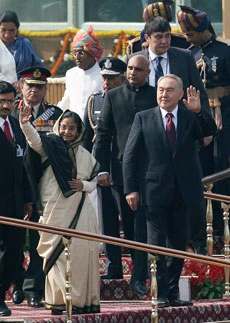
President Pratibha Patil, India’s first woman president, took salute as supreme commander of the armed forces. The chief guest on the occasion was Kazakhstan President Nursultan Nazarbayev.
President Patil gave away posthumous Ashok Chakra awards, the country’s highest gallantry award in peacetime, to 10 widows and a mother of security personnel who died fighting terrorists in Mumbai, New Delhi and Jammu and Kashmir. This is the first time such a large number of Ashok Chakras have been awarded on a single occasion.
In a ceremony steeped in symbolism, Pratibha gave away the awards to 11 policemen and soldiers posthumously. She handed over a citation and a medal to the family members of the dead security men, while a somber announcement recalled their “valiant actions and supreme sacrifice.”
The 150-minute event began with Defense Minister A.K. Antony paying homage to the Unknown Soldier at the India Gate, a World War I memorial in the heart of the capital. Antony stood in for Prime Minister Manmohan Singh, who is recuperating from heart surgery. This is the first time a prime minister has skipped a Republic Day parade.
The grand finale was the fly-past by the Indian Air Force. A variety of aircraft ranging from helicopters to combat jets zoomed across the sky and literally brought the spectators to their feet.
“The concerted and well-planned attacks in Mumbai stand out as an example of a ruthless operation undertaken to damage the confidence of India,” Pratibha said in an address to the nation. “Countries must own up to their responsibilities,” she said, without naming archrival Pakistan.
Delhi Police Commissioner Y.S. Dadwal had warned Islamist militants could try to attack the parade, which emphasizes India’s role as a regional economic and military power, as it passed through the ceremonial heart of New Delhi. “There are intelligence inputs (of possible strikes by guerrillas),” Dadwal said.
The center of New Delhi was virtually shut down for the celebrations, which attracted large crowds, and security was focused on areas close to the parade route such as metro stations and shopping centers.
Dadwal said a “ground-to-air security apparatus” was in place with anti-aircraft guns, snipers and helicopter gunships at the ready to protect the event, which passed off peacefully.
Federal Home Minister P. Chidambaram had ordered all 28 Indian states, including the seven restive northeast provinces and disputed Kashmir, to be on high alert. On Sunday, police said they had prevented a planned attack on New Delhi by killing two Pakistani militants on the outskirts of the city.
Brij Lal, a senior police officer in Uttar Pradesh state, said an anti-terrorist team chased a car carrying the men toward the capital before they intercepted it in the suburb of Noida. Police said they found two AK-47 assault rifles and five hand grenades in the car.
Manmohan missed yesterday’s events after undergoing major heart surgery. Doctors said the 76-year-old was “doing extremely well” after five bypasses on Saturday to clear blockages in his arteries.
Bejeweled elephants that have been a highlight of Republic Day festivities for decades were banned from this year’s parade due to fears about their unruly behavior and animal rights concerns.
— With input from agencies