
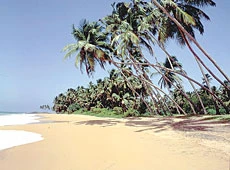
One of the greatest things about Sri Lanka, for the traveler, is the variety of places to visit. From the urban bustle of Colombo, to the beautiful mountains in the Central Hills, to the amazing beaches and islands of the sun-kissed coastline, Sri Lanka offers the visitor a wide range of alternatives when choosing a vacation.
Most visitors usually want to experience Colombo before heading out of the city. In spite of the hustle and bustle, Colombo has a lot to offer in terms of tourist attractions. The center of Colombo with its towering skyscrapers, luxury apartments, gleaming department stores, malls, casinos, pubs, karaoke bars, exclusive restaurants and luxury hotels has enough attractions to keep the visitor entertained.
Colombo turns into a Vegas-like atmosphere at night when the places of good food and entertainment open their doors and the young and the not so young are feasted to a tropical gala. Colombo at night is so separate from the day that it’s hard to comprehend that it is the same place. Colombo is a truly cosmopolitan city fueled by an unparalleled energy throughout day and night.
Colombo, the island’s largest city, is noisy, frenetic — and just a little crazy. The city is not very large and that makes it a more exciting place. Colombo is a relatively easy city to find your way around. To the north is the Fort district, the country’s business center, which has department stores, bookshops, airline offices and is the location of the Central Bank and The World Trade Center or the Twin Towers. There are also ample sights such as the clock tower, an old lighthouse, the President’s House, the Dutch Museum, and shopping areas like the World Bazaar, Main Street which is famous for textiles and shops from India and the Sea Street, the street full of gold shops or the souq of Sri Lanka.
A cluster of colonial buildings which lends the district an aura of bygone Empire still stands tall amid busy life. Most Sri Lankan towns, except the larger cities like Colombo and Kandy, are rather “undisturbed” with natural green surroundings. Large hotels, exclusive restaurants and nightclubs become busy after dusk. Some hotels, clubs and other venues also offer calypso bands and cultural performances by traditional artistes, a glimpse of art and culture of Sri Lanka.
Budget accommodation, cheap food and the best shopping can be found in the Fort and Pettah districts. Nightlife is moribund, though a visit to the cinema in the Fort district is an experience worth trying. Culture buffs shouldn’t miss the National Museum, which has a good collection of historical works, the Art Gallery, which focuses on portraiture and temporary exhibits by local artists, and the city’s many grand mosques, churches and dagabas — the white globe like structure where Buddhists pay homage with flowers, and the colorful tall structures of temples.
After familiarizing oneself with Sri Lankan culture, a guest can check out the island’s fauna at the Dehiwala Zoo. The highlight here is the elephant show and the new arrival of 20 Anaconda babies delivered by an Anaconda recently at the zoo. Such a large number has not been born to one mother, anywhere in the Asian region!
Colombo is also one of the best places in Sri Lanka to purchase, crafts, paintings, gems and jewelry, designer wear, souvenirs and the world famous Ceylon Tea, no doubt, still the world’s best!
Over one thousand kilometers of palm fringed sandy beaches encircle the Island. Sri Lanka is never out of season for a beach holiday. The beaches always have friendly and warm waters. The beach resorts in the West Coast, South Coast and the East Coast are popular among the tourists who enjoy taking a dip in the warm waters and relaxing on the sandy shore. The closest real beach in Colombo is at Mount Lavinia, a resort 10 km south of the city.
The miles and miles of coastline has some of the best beaches in the world. There are choices for all tastes and budgets. Galle is sophisticated and developed with not only great beaches but also a plethora of opportunities for sailing, diving, golf and fishing. Whether you want peace and quiet or music and action Galle, is only a short distance away.
Kandy, the Hill Capital, was the last bastion of the Sinhala kings and is a charming city offering a living record of a magnificent past.
Center of attraction in Kandy is the Dalada Maligawa. Kandy Lake enhances the charm of the City. Kandy is a romantic city any time of the year, but in August, this ancient capital becomes the venue of one of the most legendary festivals in Asia, the Festival of the August Moon when thousands of people from all parts of the country and from foreign countries throng to the Hill Capital to witness the magnificent spectacle.
The King’s Palace, audience hall, King’s Bath, the archaeological museum are musts and not to be missed by any visitor.
Botanical Gardens
The ever-beautiful Royal Botanical Gardens at Peradeniya (109 km from Colombo) near Kandy was laid out in 1821 by the British colonial rulers. Prior to that, it was the Royal Pleasure Garden of the Kandyan Kings. It is located in a beautiful setting with the longest river of Sri Lanka, Mahaweli bordering on one side.
This attractively laid out garden displays many varieties of floral and green plants. Special features are the Orchid House which displays a fine collection of Sri Lankan orchids, the fernery, spice garden, and the trees planted by distinguished visitors to the Island.
Sigiriya, a city, palace and garden complex centering a 200-meter high rock is a glowing tribute to the vision of King Kashyapa who created this “Palace in the Sky” in the 5th century AD.
On the summit of the Sigiriya Rock (meaning the “Lion Rock”) that is over 1.5 hectares in extent are the remains of a large palace, the earliest surviving royal palace in Sri Lanka, with several chambers and a bathing pond.
In a sheltered pocket of the giant rock are the celebrated paintings of 5th Century AD a few that is remaining from around 500 paintings that once covered the rock surface.
Meticulously planned water gardens at the foot of the rock are the earliest such gardens found in Asia. The boulder gardens are a fine example of landscaping while conserving the environment. The Mirror Wall, which had been exposed to elements for over fifteen centuries still carry some of the original sheen that has given it the name.
‘Little England’
The Central Highlands of Sri Lanka offer a salubrious cool climate in complete contrast to the hot climate in the plains.
The mountain slopes are covered with acres and acres of tea with its fragrant aroma mingling with the fresh air. Nestled among the mist covered central hills in a cool basin, is Nuwara Eliya, the hill resort resembling a little English village. Road leading to this hill station winds through miles and miles of “green carpet” of tea bushes where tea-pluckers are seen busily picking the “bud and two leaves” that go to form the most popular brew in the world, the “Ceylon Tea”.
In 1819, during the British colonial era, a few Britishers on a hunting expedition in the hill country spotted the site where the present-day Nuwara Eliya town stands 1890 meters above sea level and decided to set up a health resort for their use. It was Sir Samuel Baker who later converted it to a holiday resort with a touch of an English village which earned it the name “Little England” where the temperature sometimes drops down to 9 degrees C.
Sri Lanka becomes cozier while it rains and walking down the misty roads of Nuwara Eliya or in any hilly towns during a wet weather, gives an unusual pleasure to mind and soul. So, be it rainy, hot or simply a dull day ... Sri Lanka ... the land like no other, hidden with treasures, only need to be explored by every visitor.