
“Competing in the World Games is a chance of a lifetime for many of our athletes, but also a chance for the rest of the world to witness the accomplishments and victories of people with intellectual disabilities,” said Special Olympics North America Managing Director Bob Gobrecht.
Founded in 1968 by Eunice Kennedy Shriver, Special Olympics was established to create a model that embraces people’s diverse gifts. It provides people with intellectual disabilities continuing opportunities to realize their potential, develop physical fitness, demonstrate courage and experience pride, happiness and friendships.
The Special Olympics belief is that quality sports training and competition will improve the lives of people with intellectual disabilities and, in turn, the lives of everyone they touch.
Thus Special Olympics is not just as a sports organization for people with intellectual disabilities but also as a catalyst for social change.
For 30 years, the Special Olympics has strived to change and improve lives by promoting understanding, acceptance and inclusion between people with and without intellectual disabilities. It does this through year-round sports training and athletic competition for nearly three million children and adults with intellectual disabilities in more than 180 countries.
This year, participants from 20 countries throughout the Middle East and North Africa will compete: Algeria, Bahrain, Egypt, Iran, Iraq, Jordan, Kuwait, Lebanon, Libya, Mauritania, Morocco, Oman, Palestine, Qatar, Saudi Arabia, Sudan, Syria, Tunisia, United Arab Emirates, Yemen.
As winter sports are not typical for most of these countries because of their warm climates — many of their athletes have been practicing in the sand. Snowshoe racers, for example, have been training on beaches and in the desert.
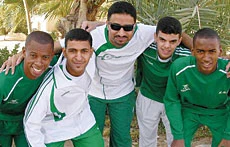
Four athletes will participate from Saudi Arabia. They are Hussain Abdul Al-Botayan, Habib Hussein Al-Olaywi, Ali Abdou Fuqayha and Faris Sayed Gharwy. Two of the young men will compete in the 200 meters and the 100 meters snowshoeing competition. The other two men will compete in the 800 and 400 meters snowshoeing races. Their coaches, Adem Mohammed Altissan and Ahmed Ibrahim Al-Duhim, will also travel with them.
The World Games will open with a star-studded entertaining Opening Ceremony tomorrow in Idaho. The athletes will then spend the rest of the week competing in alpine skiing, cross-country skiing, figure skating, floor hockey, snowboarding, snowshoe racing, and speed skating.
The closing ceremony will be on Feb. 13. (One can watch highlights of the World Games and follow the athletes at www.specialolympics.org) To encourage the athletes, more than 3,500 medals will be given throughout the games.
Special Olympics’ competing athletes and teams of the World Winter Games are divided into competition divisions based upon their ability, age and sex. As in the Olympics, those participating in the Special Olympics hope to win one of the medals — which are 24k gold and nickel-plate finished and feature a satin finish with raised, high polished logos on each side.
But the Special Olympics also will help the athletes get to know American families.
“In addition to the sports programs next week, Special Olympics also includes a ‘Host Town Program’ that allows our guests to arrive early and become acclimated to the area and time zone differences. Of the 2,100 athletes coming to Boise, most of them are staying with families,” said Kirsten Suto Seckler, media director for Special Olympics. “The families prepare all year long to host the young athletes, most of whom are in their late teens to 20s. They learn about their culture, their religion, customs and even their food. They really do a lot to try to understand the countries of origin before the athletes arrive, to help make their houseguests feel more comfortable in their homes,” said Seckler.
One previous Special Olympic champion from Saudi Arabia was swimmer, Abdel-Rahman Hassan Al-Hemdan. Only 10 years old at the time, he accomplished an unprecedented achievement for Saudi Arabia when he won two gold medals at the Special Olympics World Summer Games in Shanghai in 2007.
According to the organizers, he won the two gold medals in swimming in the 25 and 50 meters races. And the young Saudi champion captured the hearts of the Chinese spectators attending the competitions. Despite being half-paralyzed, observers said he swam “as gracefully as a dolphin.”
His father told Special Olympic organizers why his son started swimming. “It was a matter of coincidence,” Al-Hemdan, the boy’s father said. “Abdel-Rahman’s brother Youssef, and some relatives were members of a swimming team. I would take Abdel-Rahman with us to watch them train.
“He used to ask me every day to let him jump into the water, but I was afraid because of his disability, in addition to his suffering from asthma. But he insisted, so I bought him a special swimming suit and started training him with the assistance of the coaches.
“I collected info from the Internet and from books about his condition. It took us a month until he was able to hold his breath under water for three seconds,” the father told the Special Olympic organizers. “During his daily training, I tried to hide my fears in front of him. I was worried about his health condition.
“He was so patient and determined to succeed. I never found such a strong will in athletes, even the non-disabled ones. It took him a whole year of training to cover a distance of one meter. Can you imagine how determined he was? The second step was covering a distance of 10 meters and he continued until he reached that level. And amidst all that, Abdel-Rahman maintained a record in school.
“Recalling those days, that required hard training and follow-ups, I thank God for everything,” said Al-Hemdan. “He reads, writes and achieves tasks that no other child in the world could do. It was my dream for my son, and a message to show the world the real abilities of this intellectually disabled child. I’m so proud of him.”
When he won his two medals, his father said it was a remarkable moment for Abdel-Rahman. The Chinese spectators cheered for him after he won the gold medals, and he became a celebrity at the event. Everyone wanted to take photos of themselves with him, and the Chinese media named him ‘The Champ.’
“His pictures made the covers of local magazines in China, in addition to making headlines in newspapers and TV news bulletins. He also received many gifts from fans, especially from the hotel staff who were some of his greatest supporters.
“From my experience, I advise parents and families of athletes with intellectual disabilities (ID) to work for their future,” said Al-Hemdan, echoing the goals of the Special Olympics organizers.
“If we people without ID sometimes suffer when facing problems, imagine the case if it involves an intellectual disability. The Special Olympian should start training at an early age, and learn to live within a disciplined schedule. It will enable him to gain self-confidence which is very important. Parents should also learn how to help their children mingle in society.”
“Finally, Al-Hemdan believes that his son was able to convey the message of Saudi Arabia to the world which he himself wouldn’t have been able to do. “I couldn’t have done it like him. He made us all proud,” Al-Hemdan concluded.