JEDDAH: Custodian of the Two Holy Mosques King Abdullah yesterday launched eight new educational and welfare projects worth more than SR14 billion at King Saud University (KSU), including a 7.5-billion-riyal campus for women, a SR1.8-billion medical city and a SR1.2-billion housing project.
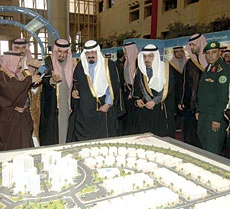
King Abdullah toured an exhibition of the models of the new projects yesterday. The other projects are: a SR1.15-billion KSU endowment project, a SR1.1 billion men’s college buildings, the National Center for Diabetes Research (SR150 million), Riyadh Techno Valley (SR89 million) and an administrative block (SR150 million).
King Abdullah and other dignitaries later watched a documentary on KSU’s progress and achievements. He then turned on an electronic screen marking the opening of the projects, the Saudi Press Agency said. King Abdullah also visited a number of patients under treatment at King Abdul Aziz University Hospital.
The king was presented a shield the KSU had received from a Spanish agency (Webometrics), which ranked the university first among those in the Arab and Muslim worlds, Middle East and Africa, and 21st among Asian universities.
Higher Education Minister Khaled Al-Anqari said the new projects included King Abdullah Institute of Nano Technology. He praised the king for his generous support to institutions of higher learning across the Kingdom. “Your presence here to inaugurate these projects reflects your strong desire to develop higher education in the Kingdom,” he said.
In his welcome address, Abdullah Al-Othman, president of King Saud University, said the university’s staff and students were proud of the king’s visit to the campus to open the new projects.
“We have been very happy for the wise initiative you have taken in unifying Arab ranks when Arab interests were in danger,” Al-Othman said referring to the initiative taken by King Abdullah to reconcile leaders of Arab countries on the sidelines of the Arab economic summit in Kuwait last month.
The president also spoke about the university’s efforts to realize King Abdullah’s vision for the development of higher education.
“This is a historic day for King Saud University as it witnessed the launch of a number of strategic projects,” he said.
Al-Othman said the establishment of Riyadh Techno Valley (RTV) was the university’s response to the Kingdom’s 8th Five-Year Development Plan in order to transform the country into a knowledge economy.
Referring to the university’s endowment project, the president said it provides a new concept about charitable work. “Endowments have many benefits to the public, and the educational benefit is the most important among them,” he explained. He called upon KSU students to become pioneers in science and research and knowledge economy. “The staff and students of this university will make you happy and you will be proud of them,” the president told the king and the large gathering of princes, senior Cabinet members and top officials. Khaled Saeed Al-Zahrani briefed the king on the first product of RTV.
Addressing the ceremony, Mohamed Al-Mady, the CEO of SABIC, said his company had given importance to scientific and technological research from the very beginning. “We have signed research agreements with all universities in the Kingdom,” he said.
Al-Mady said SABIC had developed a number of technologies and products and carried out a large-scale manpower training program. “We have now about 1,500 researchers and scientists and possess nearly 6,000 patents,” he pointed out.
During the ceremony, King Abdullah honored Abdul Aziz Al-Manie, a member of KSU’s teaching staff, for winning King Faisal International Prize. He also distributed the university’s gold medals to strategic partners of its various projects. Top executives and businessmen including Al-Mady, Abdul Rahman Al-Zamil, Mohammed Hussein Al-Amoudi, Abdullah Al-Rajhi, Bakr Binladin and Saleh Kamel received the awards. Saudi businessmen have contributed SR550 million to the university endowment project.
The king also honored Mohammed Al-Maliki, the first university staff to donate his monthly salary to the endowment project. Khaled Al-Zahrani of the university received a gold medal from the king for inventing an electronic device.