
The famous late Nobel laureate physicist and mathematician Richard Feynman (who famously solved the mystery of why the Space Shuttle Challenger exploded after takeoff in 1986) said that he could look at an equation and “feel” when it was right or solvable. Engineers, artists and people passionate about their specialty all say the same thing. They have developed a feel for the objects of their attention.
Paul Dirac, the British Nobel laureate (who posited the existence of anti-matter and was scorned for what has become a cornerstone of modern physics) shared the same vision. His brand of theoretical physics came close to philosophy. He was sure that the more “beautiful” the equation the more likely it was to be correct or accurate. He saw a picture of this world of anti-matter that was of such beauty that it had to be true.
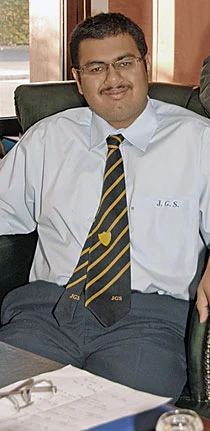
So meeting up with Saad Anwar, who scored the highest marks at AS level in mathematics, naturally prompted the question: “When you look at an equation, what reaction do you get?”
“Sometimes I just see which territory an equation is going into,” he said. “I know which way I must go.”
The world’s top AS mathematics scorer is the 18-year-old deputy head boy at Jeddah Prep and Grammar School. Born in Pakistan and for the first eight years of his life raised and educated in the US, Anwar eventually came to Jeddah with his family. Though young, he has already has the reserved and thoughtful air of a professor. He weighs every word carefully and delivers his answers precisely — very much as if wishing to communicate a particularly interesting snippet of information to a keen but yet not fully aware undergraduate.
Anwar was brought up in an atmosphere of maths. His father is the chief financial officer of a major company. Even in first grade numbers fascinated Anwar, who chooses to add and subtract huge numbers rather than the regular practice sets offered at the beginning of each maths lesson.
“I used to make up the most difficult of equations really just to show off in front of my friends,” he said with disarming honesty. “I used to venture into the millions, that kind of stuff.”
He always got them right.
Unsurprisingly, Anwar is also a very competent chess player, a game that was introduced to him when he was in second grade. Within a couple of months of starting, he was asked to play for the school team. A few months later he won his first tournament, a first for the school. Now he plays over the Internet.
“What fascinates me about chess is the calculation involved — seeing five or ten moves ahead and working out my opponent’s responses and responding to the threats. With some (opponents) I just ‘see’ their moves, but with others I have to really think about what they are up to.”
Saad said that he believes this ability crossed over into mathematics.
While not yet in his teens, he placed 25th out of 1,220 participants in the All America Cup, a tournament run by the US Youth Chess Foundation.
Anwar seemed pleasantly fazed when asked what he did for fun.
He “absolutely loves” playing basketball with his friends and listed cricket, table tennis and football among his other favorites, as well as “tinkering with things.”
“I made a hand-driven AC generator over the last month. Sometimes when I am free I try to tweak things; I am more into theory but I am not that bad at practical stuff.
His real love however is physics.
“More than half of true physics involves mathematics,” he said. “You just cannot be a hopeless mathematician if you want to be good at physics,” he said. “However physics is not just about memorizing formulae, it’s about applying them to physical systems and unraveling the secrets of the universe,” he explained. “I think the greatest skill when it comes to mathematics is applying those equations to physics. I am a natural in physics when it comes to applying those equations.”
Incidentally, he came top in AS physics in Saudi Arabia as well, following on his four earlier AS levels in Maths, Chemistry, Physics and IT.
Already he has his heart set on what he wants as a career: Electrical engineering.
“I am really fascinated by how electrical systems work,” he added.
Naturally he has researched the subject and opined that a lot of the work was theoretical in nature: “Your theory has to be very strong. The job is to design the system and do the calculations; the technician joins the wires.”
The next step for Anwar is university and his first choice is MIT.
“It has to be, and on Jan. 1 I had an interview with their representative in Alkhobar. I thought it went very well. March 15 is decision day,” he said.
He has also applied to 12 other prestigious US universities, including Stanford, Cornell, Brown, Pennsylvania and Duke.