
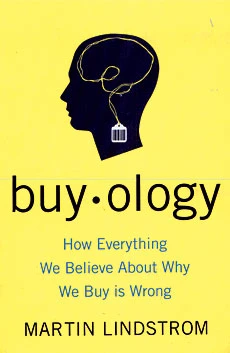
Martin Lindstrom is one of the world’s most respected marketing experts, he advises top executives of companies including the McDonald’s corporation, Nestle, Procter & Gamble, Microsoft, Unilever and GlaxoSmithKline. He has written five books and his previous book “BRAND sense” was acclaimed by the Wall Street Journal as one of the five best marketing books ever published.
In his latest best seller “buy.ology” Lindstrom shares with us the findings of a groundbreaking study. This research reveals some amazing facts about what goes on in our minds when we watch an advertisement. As a global branding expert, Lindstrom’s job is to find out: How consumers think, what attracts them to certain products, why they buy a specific brand and what can be done to boost the sales of products that are not doing well.
Six years ago, Lindstrom realized that traditional research tools, like market research and focus groups, were no longer able to predict what consumers really think. In the United States alone, companies spent some $12 billion on market research yet eight out of 10 new products are not successful. The truth is that, companies more often than not, fail to manufacture products which answer the buyer’s needs. In other words, people’s actual buying trends often contradict what they say in surveys.
According to the author, our irrational minds are flooded with cultural biases rooted in our tradition, upbringing, and a whole lot of other subconscious factors:
“That’s why the true reactions and emotions, we as consumers experience, are more likely to be found in the brain, in the nanosecond lapse before thinking is translated into words.
So, if marketers want the naked truth, the truth, unplugged and uncensored, about what causes us to buy, they have to interview our brains,” explains Lindstrom.
Neuromarketing, a combination of marketing and science, has the power to scan what he calls “Buyology” the subconscious thoughts, feelings and desires that trigger the purchasing decisions we make when we go shopping.
In 2003, Lindstrom is convinced that companies do not understand consumers because they fail more often than not to develop brands that match their needs. With the help of two scientific tools: The FMRI (Functional Magnetic Resonance Imaging) and the SST, known as the Steady State Topography, he hopes to reveal facts which have remained hidden during 50 years of market research. FMRI is a noninvasive technique which measures brain activity associated with perception, cognition, and behavior. SST uses a series of sensors to measure minute electrical signals in about a dozen areas of the human brain. It offers clues as to what cognitive functions are taking place in response to various stimuli.
One of the first neuroimaging experiments focused on which logos viewers remember when they watch American Idol, one of the most popular TV shows in the United States. The same program, in its Arabic version, is known as “Super Star”. Ford and Coca-Cola, two of the program’s main sponsors, spent the same amount of money, yet the results showed that viewers remembered Coca-Cola. The Coke advertising campaign is more effective than the Ford campaign because it is totally integrated in the program, it plays a fundamental part of the storyline. People following American Idol can see highly visible Coca-Cola glasses, furniture imitating the shape of a Coke bottle and the eye-catching Coke-red walls. American Idol’s judges also drink Coke, this simple gesture creates a strong link between the drink and the emotions triggered by the show. Long after the program has ended, viewers associate Coca-Cola with dreams, youth, music and joy. This experiment also revealed that, after viewing the show, the subjects remembered even less about the Ford advertising campaign than they had before they came in for the testing.
Lindstrom also introduces us to one of the most interesting brain discoveries of recent times, which explains why certain brands attract our attention more than others.
This phenomenon, discovered by Dr. Rizzolatti, is known as “mirror neurons”. Mirror neurons are neurons which are activated when someone is performing an action and also when that same action is being observed. These mirror neurons are responsible for why we, subconsciously, imitate other people. In terms of marketing, it means that we are affected by the clothes people wear, the food they eat, their house decoration and these feelings influence our purchasing decisions.
Another chapter deals with subliminal advertising, a term coined by a market researcher, James Vicary. According to the Federal Trade Commission, a subliminal ad causes consumers to unconsciously select certain goods or services, or to alter their normal behavior, and that might constitute a deceptive or unfair practice. However controversial subliminal commercials may be, they are still not banned.
Another interesting experiment, shows that subliminal images or logo-free-images associated with cigarettes, trigger more cravings among smokers than the logos or the images of the cigarette packs. “For companies, the logo is regarded as king, the be-all and end-all of advertising. But as our study had just shown, the logo was, if not dead, then certainly on life support… Because, as our study had proved, far more potent than any cigarette logo were images associated with smoking,” writes Martin Lindstrom. Some companies, like Ralph Lauren, Philip Morris and Abercrombie & Fitch already use logo-free ads.
Advertisers also use powerful somatic markers, which influence our decision to buy a specific brand. Somatic markers constitute a blend of memories, facts, emotions, beliefs and thoughts which strongly influence our decision to buy a certain brand without us being consciously aware of it. For example, we often prefer to buy a Michelin tire because we immediately think of the Michelin man whose plump figure suggests the protective padding of a well-made tire.
Although, the science of neuromarketing is still relatively unknown, a growing number of companies, including Christian Dior, Microsoft and Unilever, are using it, convinced of its advantages: It is a known fact that 90 percent of our consumer buying behavior is unconscious.
In this latest best seller, Martin Lindstrom shows us what really goes on in our minds when we see an ad, watch a TV program sponsored by major companies or go shopping. At the end of the book, we are left with the belief that advertising agencies will definitely use neuromarketing in order to better target our subconscious wishes and desires. More than ever, we should be aware of the tricks used by companies to seduce our senses, subdue our reason so we buy exactly what we have been programmed to buy.