
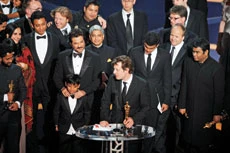
LOS ANGELES: Hollywood has met Bollywood at the Academy Awards, and the makers of Oscar champ “Slumdog Millionaire” hope it’s a sign of future melding between the US dream factory with its counterparts in India and elsewhere in the world. A tale of hope amid adversity and squalor in Mumbai, “Slumdog Millionaire” came away with eight Oscars, including best picture and director for Danny Boyle.
The low-budget production was a merger of India’s brisk Bollywood movie industry, which provided most of the cast and crew, and the global marketing reach of Hollywood, which turned the film into a commercial smash, said British director Boyle.
“We’re Brits, really, trapped in the middle, but it’s a lovely trapped thing,” Boyle said backstage. “You can see it’s going to happen more and more. There’s all sorts of people going to work there. The world’s shrinking a little bit.” It was a theme Oscar voters embraced through the evening with other key awards honoring films fostering broader understanding and compassion.
As expected, Australia’s Heath Ledger became just the second performer to win an Oscar posthumously, receiving the supporting-actor award for the menace and mayhem he wreaks as Batman villain the Joker in “The Dark Knight.” The previous posthumous Oscar recipient was the British-Australian actor Peter Finch, who won best actor for 1976’s “Network” two months after his death.
Penelope Cruz was the first Spanish actress to win an Oscar with her supporting prize as a volatile artist in a three-way romance in Woody Allen’s “Vicky Cristina Barcelona.”
“Slumdog Millionaire” started as an unlikely candidate for the sort of industry and audience recognition it has garnered, presenting a cast of unknowns and a Dickensian tale of an Indian orphan rising above his street-urchin roots. Though set in a foreign land, the film, adapted from Indian Vikas Swarup’s novel “Q&A,” tells a universal story of optimism that has been eagerly embraced by US audiences.