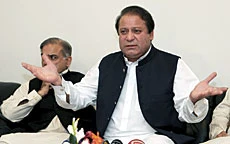
ISLAMABAD: Pakistan’s Supreme Court yesterday barred former Prime Minister Nawaz Sharif from contesting elections and declared null and void the election of his younger brother, Punjab Chief Minister Shahbaz Sharif, leading to the fall of the Pakistan Muslim League-Nawaz (PML-N) government in the country’s largest and most politically consequential province.
Protests broke out all over the country, particularly in Punjab, the power base of the PML-N. The decision led to the Karachi Stock Exchange falling by 300 points.
The Supreme Court ruling came through a brief verbal order issued by a three-judge bench led by Justice Musa Leghari.
The Supreme Court bench was hearing petitions challenging the Lahore High Court’s order disqualifying Sharif, chief of the PML-N, from contesting elections. The Supreme Court upheld the Lahore High Court decision. “All petitions have been dismissed by the Supreme Court,” senior lawyer Akram Sheikh told reporters.
With Shahbaz Sharif out of the chief minister’s chair, Punjab Gov. Salman Taseer now controls the reins in the province. The Supreme Court is yet to issue a detailed order.
The move triggered a political showdown as Sharif accused President Asif Ali Zardari of manipulating the verdict to throw him out of politics and urged the nation to rise up against the court order. “This is not an attack on us, but an attack on Pakistan. We have to hold accountable all those people who are bent upon destroying Pakistan,” he told reporters in Lahore. “The nation should rise against this unconstitutional decision and this nefarious act of Zardari,” he said.
“Now the case has come to the court of the 160 million people of Pakistan. I think the nation will have to rise against such actions,” he said. “We should save the country against potential dangers.”
In a sign of his influence and power, visiting US officials frequently travel to Sharif’s palatial home to meet him, the most recent being Richard Holbrooke, the American envoy to Pakistan and Afghanistan.
A court in Lahore ruled last June that Sharif, ousted by Musharraf in a 1999 coup, was ineligible to stand in a by-election because of criminal convictions. He was convicted of “hijacking” a Pakistani commercial airliner carrying Musharraf after denying the aircraft landing rights while he was prime minister on Oct. 12, 1999. The plane eventually landed and Musharraf seized power.
The Sharif brothers refuse to recognize any judge appointed by Musharraf under emergency rule declared in November 2007. The PML-N campaigns to reinstate judges sacked by Musharraf and Sharif accused Zardari of reneging on promises to do so.
“We badly need national reconciliation. This (judgment) is not good for the country and not good for this region,” said Awami National Party (ANP) chief Asfandyar Wali.
Analysts said that conflict between PML-N and Zardari’s Pakistan People’s Party (PPP) threatened the country’s fragile democracy by replaying the 1990s, when the two parties repeatedly toppled each other’s government, culminating in a coup in 1999.
“The future of democracy will be in serious question,” said Hasan Askari Rizvi, a political analyst in Lahore. “The (Islamabad) government will find it difficult to cope with governance because political survival will be the main consideration for them.”
“To me this is not a judicial decision, it is a political decision which will lead the country toward further political instability,” said Rasul Bakhsh Rais, professor of political science at Lahore University of Management Sciences.
— With input from agencies