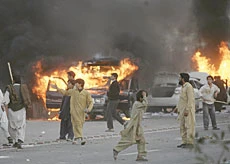
ISLAMABAD: Life in Pakistan’s Punjab province came to a standstill yesterday as supporters of former Prime Minister Nawaz Sharif protested a court decision to bar him from contesting elections and the federal government’s move to impose governor’s rule on the populous province.
The Supreme Court on Wednesday barred Sharif and younger brother Shahbaz, chief minister of Punjab, from contesting elections over their earlier convictions.
Yesterday, a strike was observed in Punjab, the political bastion of the Sharifs, with schools, colleges and shops closed in all towns and cities. At least six vehicles were torched by angry demonstrators on Express Highway. Shop windows of some stores were broken and at least one bank was attacked in Rawalpindi.
The situation was tense and the paramilitary Rangers were called in to deal with the violence.
The court decision prevents Sharif from challenging President Asif Ali Zardari in general elections in 2013.
Zardari compounded the crisis by dismissing the Shahbaz-led government in Punjab and putting its governor — a Zardari loyalist — in charge.
Some 20 lawmakers from Sharif’s Pakistan Muslim League party were herded into police trucks as they gathered yesterday for a protest at the Punjab Assembly in the eastern city of Lahore. Police let them clamber out as the crowd swelled with supporters who swarmed past barriers and banged on the wooden doors of the assembly building. The lawmakers later held a mock parliamentary session on the steps. “We are democrats, and what we are seeing today is shameful,” lawmaker Rana Iqbal said.
Prime Minister Yusaf Raza Gilani, who is a member of Zardari’s Pakistan People’s Party, called for calm and unity of democratic forces and warned against the danger of undemocratic powers taking advantage of the situation.
Talking to reporters after a briefing at the Ministry of Health, Gilani said he was saddened by the Supreme Court decision.
Asked about the possibility of a review of the decision, he said: “It can’t be ruled out.” He was referring to President Zardari overriding the court ruling.
To a question whether he gave his consent to the imposition of governor’s rule in Punjab, Gilani said a “vacuum” had been created and under the rules of business the prime minister’s advice was necessary. Asked whether the attorney general sought his advice about the case, the prime minister said: “No, he did not consult me.”
Sharif has accused Zardari of orchestrating the court decisions and called for protests. He has also urged his supporters to join mass rallies planned for mid-March by lawyers, whose protests for an independent judiciary undermined Pervez Musharraf’s long rule.
Dozens of judges who were ousted when Musharraf imposed emergency rule in 2007 have returned to the courts under the year-old government led by Zardari’s party.
But the government has blocked the return of Iftikhar Mohammed Chaudhry, the former chief justice who questioned a pact that quashed long-standing corruption charges against Zardari and his slain wife, former leader Benazir Bhutto.
— With input from agencies