
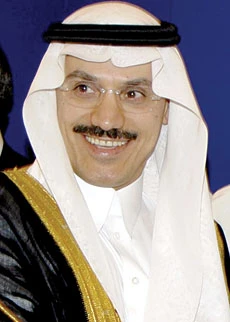
LONDON: The appointment of Muhammad Al-Jasser last month as the new governor of the Saudi Arabian Monetary Agency (SAMA) has been widely welcomed by regulatory officials and bankers both in the Kingdom and abroad.
Al-Jasser up to now served as the vice-governor of SAMA. He succeeds Hamad Al-Sayari, the former SAMA governor. Al-Jasser’s appointment was announced by Custodian of the Two Holy Mosques King Abdullah. The governorship of SAMA carries the rank of minister, which means that Al-Jasser will also sit in the Saudi Cabinet.
The differences in style and personality between Al-Sayari and Al-Jasser could not be more stark. The former, according to bankers, is an introvert — quiet, cautious and bureaucratic. The latter is more proactive, outspoken and approachable. As such, foreign regulatory officials and bankers expect a much more proactive policy approach from the new governor. Others expect SAMA under Al-Jasser to open up to Islamic banking in particular and to show leadership in this field in the light of the growing globalization of the industry.
At the last annual summit of the Islamic Financial Services Board (IFSB) held in May 2008 in Amman in Jordan, Al-Sayari was the only regulator attending the summit who did not address the delegates. Instead, he preferred to chair one of the sessions, thus depriving those attending of hearing first hand the state of the Islamic finance sector in the Kingdom. The lack of leadership in the sector from the Kingdom, which has the largest pool of funds in global Islamic finance, under the watch of Al-Sayari, disappointed many players in the industry.
“We have had an excellent working relationship with Al-Jasser, especially during his time as vice-governor,” confirmed the CEO of a top Malaysian Islamic bank which has applied for a license in the Kingdom. “We are confident that the Islamic financial services sector, both in Saudi Arabia and elsewhere will receive a major boost under the tenure of Al-Jasser. We look forward to working with SAMA. Al-Jasser is very supportive of the Islamic finance industry. He will prove to be far more proactive than Gov. Al-Sayari.”
Indeed, the market got a foretaste of this proactiveness at a recent financial and economic conference in Riyadh where Vice-Gov. Al-Jasser, unusually for a Saudi bureaucrat, could not have been more forthright in stressing that “there was a dismal failure of regulatory oversight” in the financial services markets in the West especially in the US, UK and Western Europe. In contrast, the Kingdom has been planning precisely for such a rainy day. “In the good days, we rebuilt our reserves and paid down debt so we could cushion the economy and spend more than we are taking in during the bad times. Now our reserves will come down. We were accused of micro-managing. They said that SAMA was intrusive when we said “slowdown”. Now they want to kiss our foreheads. We never ceased believing that regulation must be part of the financial markets. The private interest of bankers must be guided like traffic. The rules must be applied to prevent excessive risk taking,” he explained.
This prudent regulatory stewardship of the Saudi financial and banking sector over the last few years has been vindicated as Saudi-based financial institutions have been much less affected by the fallout of the credit crunch and the impact of the global financial turmoil. While some banks in neighboring Bahrain, Kuwait and Dubai have reported exposure to the US subprime CDOs (collateralized debt obligations); or to overexposure to the real estate market or even commodity receivables such as reverse Murabaha, resulting in some of the cases to more than $3 billion of write-offs, Saudi banks are weathering the storm and in fact are looking forward to 2009 and 2010 with much greater optimism than their Western and international counterparts.
For this, much of the credit, however, must go to Al-Sayari, who in 2005, increasingly concerned by the wanton speculation on the local Saudi share market, had already been reining in local banks and warned their senior executives that their banks should not to finance excessive speculation in the capital markets. Perhaps it was a bit too late to pre-empt the “irrational exuberance” in the Saudi stock market which led to a 30 percent market correction in March 2007 which was effectively a wake-up call for both ordinary Saudis and institutional investors.
Local bankers such as John Sfakianakis, chief economist at SABB (Saudi British Bank) strongly support SAMA’s prudent policy. “Unlike the speculative real estate lending that was witnessed in some parts of the Middle East, Saudi banks have adhered to a balanced and conservative loan book. Saudi Arabia can weather the global recession far better now than before and far better than most members of the G-8. Even if oil prices average $30-$35 a barrel for the next two years Saudi Arabia’s economy will face manageable headwinds. If the US economy is undergoing a heart transplant Saudi Arabia is facing a cold snap.”
SAMA under Al-Sayari has also had its low moments. A few years ago, the Saudi regulator was ineffective when tens of real estate companies, mostly unregistered with the commerce and regulatory authorities, were collecting billions of riyals in unauthorized deposits from hapless investors, many of them poor expatriates, offering Shariah-compliant investments with a promise of outrageously high returns. When the investments started going wrong, SAMA was conspicuous with its silence and lack of action.
At a time when the global financial sector is looking for “fit and proper” leadership, perhaps the appointment of Al-Jasser as the new governor of SAMA could underline a new beginning for the Saudi economy and the financial sector in general, and the global Islamic finance sector in particular.