
Life in Cairo is infused with a lingering sense of history: The past is present everywhere. Yet despite the chaotic and noisy atmosphere, it is so easy to travel through time. No other city in the world can offer simultaneously a medieval Islamic city and the Pyramids, the world’s oldest tourist attraction, visible from the upper storeys of high-rise buildings throughout the capital.
One of Cairo’s irresistible charms lies hidden in the maze of lively streets, especially in traditional areas such as the Old City where not very much has changed for hundreds of years. Unlike the sterilized and lifeless avenues of many Europeans towns which are often empty and silent in the evening, Cairo’s streets are always boisterous and swarming with people. Donkeys, horses and picturesque ambulant vendors bring to the Cairene streets an inimitable liveliness and vibrancy.
The saying goes that if the rich set off fashion trends, the poor preserve traditions. This is especially true of Cairo where the less affluent still buy hot food and snacks from mobile kitchens on carts. This habit goes back to the Middle Ages when itinerant caterers cooked hot food because the prohibitive cost of fuel prevented many families from having their own kitchens.
Ful and taamiyya, a national staple food, are sold on nearly every street of the capital. Ful is pureed fava beans simmered in a large round brass pot, “idra” — with its unmistakable narrow neck. The street vendor mashes the fava beans with oil, lemon, salt, cumin, and chili and places the mixture into “esh baladi” — local bread. A hard-boiled egg can be added to the mixture for a more substantial meal. Taamiya and ful sandwiches are generally eaten for breakfast while “kushari” and liver sandwiches are served in the afternoon.
Kushari, a nutritious dish, is a tasty mixture of brown lentils, rice and pasta. All these ingredients are mixed together, topped with a spicy tomato sauce and fried onions and then served on a metal plate or spooned into a polythene bag for a takeaway.
Another popular street food is “kibda” — liver. Fried liver is generally served with a spicy tomato sauce or “tahina” (sesame paste) and put into a piece of bread with some pickles.
It is not advisable to eat street food in Egypt if you are not used to it; however, it is quite safe to sample the delicious roasted sweet potatoes. During the winter, vendors stack mounds of sweet potatoes and a small charcoal oven onto their mobile carts. As they roam the streets of Cairo, they leave behind a wonderful aroma which whets your appetite even if you are not hungry! Roasted sweet potatoes are served, steaming hot, wrapped in sheets of newspaper and, eaten whole in their caramelized skins.
In Cairo, one knows the season just by looking at the street vendors. If the roasted sweet potato reminds us of the cold winter season, grilled sweet corn is a familiar sight during the hot summer months. Unlike Lebanon where people favor boiled corn, in Egypt, street vendors shuck the corn and grill it over a charcoal fire set in a small metal receptacle. The corn is served piping hot and placed once again in its shucks.
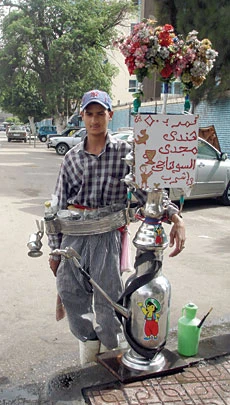
The licorice juice vendor is also a typical sight in the summer. The juice and the ice are placed in a large flask, surrounded by drinking glasses and strapped onto the vendor’s shoulder. Some licorice vendors still wear the traditional baggy trousers with satin cummerbunds and you might even hear them beckon their customers by singing out loud: “This is the wonder! Sweets from wood!” To serve the juice, the vendor tilts the flask from a distance into the glass and releases plenty of air bubbles which then form a thick foam.
Another picturesque scene is the “bayya il-tirmis,” the lupine seller with his creamy yellow seeds. Every now and then, he sprays the “tirmis” with water to keep them moist. Lupine seeds are tasty when they are salted and sprinkled with lemon juice and powdered cumin.
The whole year round, street vendors sell “libb” and “sudani” that is roasted watermelon and pumpkin seeds as well as peanuts. Cairenes enjoy eating “ libb” while strolling along the Nile Corniche and, most of all, while watching popular serials on television.
Despite their problems, Cairenes are outgoing, brave when faced with adversity and always ready for a laugh or a lively conversation. This ability to create happy moments, reflects on the city: Cairo is always brimming with life, day and night!
It is always pleasant to stroll along the streets of Cairo and experience the exhilarating pace of life. Cairo might lose some of its architectural beauty and uniqueness every day but its greatness lies in its immeasurable knowledge of having lived in the same place for more than five thousand years and, even more so, in the hearts of its people.