ISLAMABAD: Pakistan's former Prime Minister and leader of the main opposition Pakistan Muslim league (N) Nawaz Sharif vowed yesterday to change the country’s destiny as he urged the masses to defy a government clampdown and join a nationwide protest.
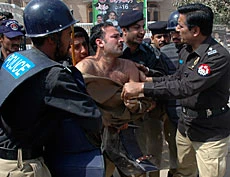
“Today is a defining moment in Pakistan’s history. We can change the destiny of this country. Pakistan stands at a crossroads today and it is your duty to save it,” Sharif told a rally in the northwestern town of Abbottabad. The authorities arrested dozens of lawyers in a bid to thwart the protest, and outlawed demonstrations in Islamabad, as well as in the provinces of Punjab and Sindh, through which the rally is to proceed.
The protesters want President Asif Ali Zardari to act on promises to reinstate judges, including Supreme Court Chief Justice Iftikhar Muhammad Chaudhry, sacked by former President Pervez Musharraf. Zardari is refusing to do so, apparently fearing they could try to limit his power or reopen corruption cases against him.
Last month, the Supreme Court banned Sharif and his brother Shahbaz from elected office, enraging the leader’s followers and energizing the protest movement further.
“We want to change this outdated system because it poses a danger to our existence and they want to charge me for sedition,” Sharif told the rally of thousands of supporters, who cheered and waved party banners. “I ask them (the government) can this law stop the flood of people?”, he asked.
Organizers hope tens of thousands, if not hundreds of thousands of people will join a four-day protest march to Islamabad, which begins today in the southern city of Karachi and ends in the capital on March 16.
“We shall meet on March 16 and change the destiny of Pakistan.” Twice a former prime minister of Pakistan, Sharif was last month banned from contesting elections and is locked in a showdown with Zardari.
The government banned protests in two provinces and arrested scores of opposition activists yesterday.
The Interior Ministry confirmed detention of 400 lawyers and opposition activists.
Federal Information Minister Sherry Rehman told a press conference, “We believe in democracy but when we are pushed to the wall we have to establish law and order through administrative measures.”
Prime Minister Yousaf Raza Gilani said yesterday evening the governor’s rule in Punjab would end soon. He said he would meet Punjab Governor Salman Taseer today to discuss the situation and end governor’s rule in the province.
The crackdown by police and intelligence agencies stands to damage the democratic credentials of the ruling party of President Zardari and stoke further anger at the government’s one-year-old rule. The lawyers and opposition vowed to continue their protests.
The upheaval comes as nuclear-armed Pakistan is grappling to contain surging violence by Al-Qaeda and the Taleban and fix the economy.
The protesters have vowed to gather in cities around the country today before leaving for Islamabad, where they plan to stage a sit-in at the Parliament building until their demands are met.
Ban on rallies in Punjab will remain in force for three months and give authorities the right to arrest any protester, Rao Iftikhar, the home secretary of Punjab, said.
Meanwhile, Sindh province Home Secretary Arif Ahmad Khan outlawed public gatherings of more than four people for 15 days.
The US, which supported Musharraf but is backing the civilian government, has yet to make any public statement on the crisis. Last week, Britain appealed for political unity, saying the bickering was distracting Pakistan from the “mortal threat” posed by Al-Qaeda and the Taleban.
A spokesman for Sharif’s party, Sadiqul Farooq, said he received reports from party offices across the country that members were being arrested, but he had no accurate numbers. Munawar Hassan, a leader of the Jamaat-e-Islami Pakistan party, said “nearly two dozen of our supporters have been detained.”
In the Punjab city of Multan, senior police officer Fayyaz Ahmad said 42 Sharif supporters were arrested and “would be dealt with according to the law.”
On Monday, the country’s security chief said the protesters were welcome to rally, but urged them not to gather in front of the parliament, suggesting an empty lot on the outskirts of the capital instead.
Aitzaz Ahsan, a protest leader, said he believed “hundreds” of lawyers had been arrested, but insisted the movement — which helped bring down the government of Musharraf — would not falter.
“How long can the state resist?” he told a local TV station. “We will keep on knocking on the door of Islamabad relentlessly.” Zardari is the widower of slain former Prime Minister Benazir Bhutto, who was widely praised as a democrat. He has repeatedly promised to implement her vision in the country of 170 million people.
Bhutto’s and Sharif’s parties were bitter rivals in the 1990s, a turbulent decade when both leaders served twice as prime minister without completing a term before Musharraf seized power.
The moves to arrest the protesters were reminiscent of crackdowns on the lawyers under Musharraf’s rule and drew derision from some analysts.
“At the moment what we are witnessing ... indicates this government has shades of autocratic rule,” said Zaffar Abbas, a journalist and commentator.