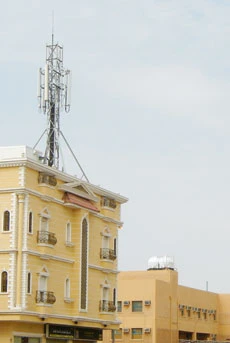
JEDDAH: Last week’s claims by the National Society of Human Rights (NSHR) that telecom companies have violated the Kingdom’s laws by setting up mobile cell phone towers in residential areas has led to companies denying the claims saying they are vague and baseless.
According to the NSHR statement, Minister of Municipal and Rural Affairs Prince Miteb issued a circular five years ago banning the installation of mobile phone towers and telecom receivers in residential neighborhoods.
Talal Qusti, head of the Environment and Safety Committee at the NSHR’s Makkah branch, said regulations have been ignored due to contracts signed with telecom companies. Telecom companies, however, said they are not breaking the law and have been following procedures from before the establishment of a telecom authority in the Kingdom.
“The Saudi Telecom Company (STC) is fully aware of regulations regarding the placement of its mobile phone towers and is fully approved to install network infrastructure equipment in all residential areas since mobile services initially started in Saudi Arabia,” Abdulaziz Al-Shamsan, director of STC’s marketing communications and public relations, told Arab News.
Al-Shamsan said that STC is an active member of the community and strives to ensure the safety of its equipment while adhering to strict guidelines. “STC is a licensed operator in Saudi Arabia, and the first in providing mobile services and in implementing rules even before there was a regulator,” he said.
He added that there are strict internal rules governing the issue, ensuring telecom companies get permission from all involved parties before installation.
In fact, according to the specifications drawn up in November 2006 by the Communications and Information Technology Commission, the Saudi Regulatory Communications Authority (Articles 33 and 35 of Chapter Nine) explains that all operators enjoy equal rights to public and private properties for providing telecommunications services.
Article 34 states: “The operators after obtaining the approval of the property owner or his representative can enter a property and use it within the necessary limits for purpose of the construction, operation, and maintenance of telecommunications’ networks.”
Article 35 adds that if for some reason the operator and the property owner fail to reach an agreement on the amount to be paid to use the property, or for any other reason, then the operator can submit a request to the commission for the expropriation of the property.
Majed Al-Mesmar, Mobily’s director of network development in the Western region, said: “The Ministry of Municipality Affairs and Villages issued a list of regulations and standards in 2004 governing the selection of locations (rooftops or fields) for telecom sites. Mobily strictly adheres to this.”
He added that Mobily pays annual rental fees to landlords. He, however, refused to comment on the exact amount saying it varies from area to area, and is based on population figures and the importance of the location.
When asked about claims that the towers could cause cancer and other health problems, Al-Mesmar said: “A study on the harms and effects that could be caused by installed Radio Base Stations (RBS) around the city was requested in 2006 by Prince Salman bin Abdul Aziz. A committee of members from the Ministry of Health, the King Abdul Aziz City of Science and Technology, and the Communications and Information Technology Commission was formed. The prince’s office clearly mentioned that there is no solid evidence that installed RBS sites cause harm to members of the public living nearby.”
Al-Mesmar said RBS equipment is manufactured according to international standards that guarantee a safe level of radiation. “Furthermore, all RBS equipment gets tested and verified against international standard specifications before being put into service,” he added.
He further said that Electromagnetic Radiation (EMR) can only be dangerous if emitted radiations are beyond safety limits or if the frequency of the radiation (ionizing radio frequency) falls within 0.3-30 Ehz (exahertz or million gigahertz) as in gamma rays and X-rays.
Existing cell phone sites, Al- Mesmar maintained, operate the frequency range between 850 to 1900 megahertz, also called non-ionizing radio frequency.
A representative from within the telecom industry said: “The problem with the NSHR report was that their claims had little solid evidence and gave a very vague and baseless view of exactly how telecom companies are ignoring the law,” he said, concluding that the sector is strictly regulated by the CITC and failure to abide by any of the set laws would result in financial penalties and ultimately a loss of licensing to operate in the Kingdom.