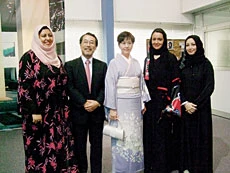
JEDDAH: The qualities of a good teacher can depend on one’s perception and experience. Appearance, attitude to students, knowledge, personality traits, teaching practice and work habits may be some of these qualities, although not in the same order. This was the focus of an interactive exercise featuring the first meeting of the newly formed Jeddah chapter of the Kingdom of Saudi Arabia Association of Language Teachers (KSAALT) held at the Gallery Seminar Room of Effat University library over the weekend.
KSAALT, TESOL’s (Teachers of English to Speakers of Other Languages) only affiliate in Saudi Arabia, is based in the Eastern Province; its Riyadh chapter is slated for opening in due course.
In her opening address, Effat University Dean Haifa Jamal Al-Lail said the establishment of the new chapter was an achievement for KSAALT. “The Jeddah chapter has been established in less than a year after the first KSAALT conference,” she said.
“Teaching and learning languages is an important area of learning and development, and KSAALT will provide language educators the opportunity to collaborate in order to promote excellence in teaching,” said Al-Lail, adding that the chapter is open to everyone interested in language education.
In addition to language teachers, parents can also join the organization and benefit from its sessions, she said. “The chapter will be a source of continuous professional development for language educators and will emphasize the importance of language education.”
Through its international affiliation with TESOL, the new KSAALT chapter aims to provide inspiration and professional development opportunities to language educators, and to generate awareness and interest in language education, said Sarah Zafar Khan, English instructor and director of the university’s Effat English Academy (EEA), in a presentation on the chapter’s mission.
“Through the KSAALT platform, language teachers will be able to collaborate with other language educators and stay current in the field of language teaching by sharing knowledge, ideas, techniques and experience,” said Khan who is also chapter representative.
Khan said those teaching languages other than English, such as Arabic, could also become chapter members.
The chapter aims to guide teaching and administration, connect theory to practice, align teaching philosophies with best practices, promote institutional collaboration and inspire teachers to conduct research. Its members can contribute by presenting papers and workshops at KSAALT meetings, writing for the KSAALT Newsletter, participating in e-mail discussions, sharing ideas, resources and difficulties, initiating institutional collaboration, conducting action research and disseminating findings.
Khan also held an interactive presentation on the “Qualities of a Good Teacher.” The meeting also featured a workshop on “Student-Centered Language Teaching” by Canan Celik, EEA instructor and chapter secretary.
Effat University, which recently gained university status, has three colleges: The College of Humanities and Social Sciences (comprising the departments of early childhood education, English and translation, and psychology), the College of Engineering (comprising the departments of architecture, electrical and computer engineering, computer science and information systems) and the College of Business.
EEA offers pre-college general and academic English courses that vary in duration from six to 16 weeks. Its General English Program covers basic communication skills, and reading, writing, listening and speaking, as well as Computer-Assisted Language Learning (CALL) at two levels of six weeks each.
Equipped with modern teaching aids and technology, as well as foreign qualified and highly experienced faculty members, EEA provides a foundation for learning English, equip learners with academic skills that promote appreciation for learning and inspire leadership qualities.
Formerly known as Effat College, the university began its operations in 1999. It had its beginning at Dar Al-Hanan School in 1955.