JEDDAH: Ilham Al-Dakheel, CEO of Al-Raeda for Education Development, launched a new approach to education in Saudi Arabia with the introduction of two structured preschool programs. Based on the Montessori system of early education, the schools’ focus of attention is the fact that children’s intellectual, emotional and social development is at its peak between the ages of three and six.
She said that the majority of a person’s intelligence, personality traits and language abilities develops before the age of six. “It is therefore vital for the readiness of our youth in a globalized and competitive world that we prioritize their education and development very early on, even before elementary schooling.”
Fewer than one in 10 Saudi children aged between three and six receives any formal preschool education in Saudi Arabia. Al-Dakheel noted that by comparison Bahrain had about 45 percent and the United Arab Emirates 65 percent of children in the age group in formal preschools. “Globally, many developed countries have enrolment numbers close to 100 percent. There are no cultural or economic reasons that can justify our gap,” she said.
Al-Dakheel described the school’s mission as helping to provide the opportunity for a quality preschool education for every child. Saying that the gap between the availability of preschooling and the ideal was too big to rely solely on the government to close it.
“We want to make our contribution and hopefully encourage other responsible private sector operators to do the same,” said Al-Dakheel. “Al-Raeda’s goal is to provide 10,000 children with high quality preschool education within five years,” she said.
Asked what qualifications a child needs to attend the schools, Al-Dakheel said that they were open to all children. “We screen the parents rather than the children because we need their support and input in the education process,” she said. “We cannot do it alone.”
Al-Dakheel also noted that most children’s sense of discipline, relationships with others and behavior control develops by the age of six, and so does their ability to learn languages.
The classes of 20 children have two teachers, one speaking only English, the other Arabic. “The children learn both languages naturally in their daily activities,” she said.
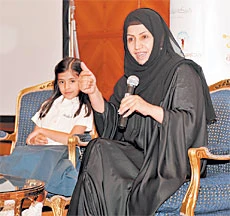
To illustrate the point, she introduced a young graduate of the system, Rana Al-Sadham, who described her learning experience animatedly switching between the two languages without a pause.
Al-Dakheel added that preschool attendance had been proven to improve academic performance, strengthen positive traits such as independence and self-confidence, and reduce behavioral issues among young adults.
After more than two years of planning, research and development, Al-Raeda will launch two chains of schools, Ambassadors and Intilaka, to serve different economic segments of society.
The Ambassadors schools, to launch in Jeddah and Riyadh in 2009, offer a program based on the Montessori educational method. The program, with a proven track record in the Kingdom for 15 years under its previous name, Asrary School, emphasizes academic skills, personality development and a full mastery of both English and Arabic. It also integrates Islamic teachings and values seamlessly across the curriculum.
The Intilaka schools will draw on Al-Raeda’s deep Saudi and educational expertise to offer a top-quality preschool program where children are set in small groups of 12 to allow proper attention and focus. The Intilaka program was developed with regional and global academic experts. It features an Arabic language curriculum with rich daily English classes delivered by fluent speakers; it also puts emphasis on math, science, and religion.
“Our objective is to make Intilaka a reference name in the Kingdom for high-quality preschool education. Our objective is to be able in a few years to look back and demonstrate with actual facts that our Intilaka children are better students and more rounded individuals who are better prepared for what awaits them in the future,” said Al-Dakheel.