RIYADH: Custodian of the Two Holy Mosques King Abdullah has approved a $1 million grant to provide polio vaccines to 3.8 million children in Afghanistan.
The agreement for a six-month polio eradication campaign was signed yesterday between UNICEF and the Saudi Committee for the Relief of the Afghan People, headed by Prince Naif, second deputy premier and minister of interior.
Saed Al-Harithi, adviser to the interior minister and head of the Saudi Committee for the Relief of the Afghan People, and Ayman Abu Laban, UNICEF Gulf Area representative, signed the agreement yesterday in the presence of Sigrid Kaag, the visiting UNICEF regional director for the Middle East and North Africa.
“Thanks to this generous donation, we will be able to provide polio vaccines to 3.8 million Afghan children and will help them enjoy a healthier life,” Kaag said following the signing ceremony.
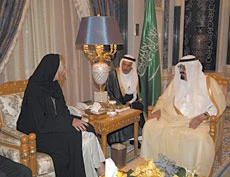
Kaag, who wrapped up a two-day visit to the Kingdom, held talks with King Abdullah yesterday. She said her discussions with the king centered on the situation of children in Saudi Arabia. “We are encouraged by the progress that Saudi Arabia has made in protecting children’s rights and are confident that more will be done to ensure that all children are safe from harm, abuse and exploitation,” Kaag said.
Kaag’s talks with King Abdullah also included children’s rights in Islam and child marriages.
According to statistics, 93 percent of Saudi children attend primary school and the country is on track to achieve universal primary education by 2015. UNICEF estimates the under-five mortality rate in the Kingdom at 25 per 1,000 live births, a significant decrease from 44 per 1,000 live births in 1990.
However, more needs to be done to address issues including the protection of children from trafficking, violence and harmful practices like early marriage. “We welcome the resolve of Saudi authorities in addressing the issue of child marriages,” said Kaag.
UNICEF works closely with the Saudi government and other partners to fully realize children’s rights through addressing youth and adolescent needs and issues; preventing domestic violence, abuse, and child trafficking; and protecting children who come into contact with the law, said Kaag, who also met with Interior Minister Prince Naif, Foreign Minister Prince Saud Al-Faisal and Social Affairs Minister Yousef Al-Othaimeen, as well as senior government officials and representatives of nongovernmental organizations.
Kaag also held discussions with Mufleh Al-Qahtani, president of the National Society for Human Rights, and officials from Prince Naif University.
The visit was also marked with the launch of DevInfo, a data monitoring system on the state of children in Saudi Arabia, in partnership with the Saudi National Committee for Child Welfare.