
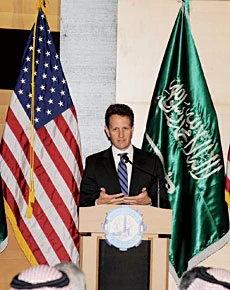
JEDDAH: US Treasury Secretary Timothy F. Geithner said here on Tuesday that the economic policies put in place in the United States and around the world had helped arrest the financial crisis, slowing the pace of decline in economic growth, pulling the global financial system back from the edge of failure and establishing the basis for recovery.
“The force of global recession is receding,” he told a meeting at the Jeddah Chamber of Commerce and Industry (JCCI) presided over by its Chairman Muhammad Al-Fadl. Leading businessmen were among those present at the meeting where Geithner invited more Arab investment in the US economy.
Acknowledging massive investments by Gulf states, he stressed that the (related) security issues had been addressed.
“I think the world has yet to fully appreciate the scale of ambition and investment we are seeing in the Kingdom and the rest of the Gulf in order to lay the foundation for future growth,” he said.
Geithner, who read his address from a prepared text and later answered questions from JCCI members, has a busy itinerary including meetings with Custodian of the Two Holy Mosques King Abdullah, his advisers and Finance Minister Ibrahim Al-Assaf before departing for Abu Dhabi.
“The purpose of these meetings is to underscore President (Barack) Obama’s commitment to strengthening our relationship, review progress in our coordinated strategy to restore global growth, examine the risks and challenges still ahead of us, and move the G20 reform agenda forward,” he added.
In Saudi Arabia, the nonoil economy continues to grow, boosted by one of the largest stimulus packages of any G20 nation and by aggressive monetary and financial sector actions. “On the strengths of the global policy response, and these signs of initial traction, the IMF (International Monetary Fund) recently upgraded its global forecast, predicting 2.5 percent growth for 2010, slower than typical for recoveries, but recovery nonetheless,” Geithner said.
The process of repair and recovery is going to take considerably more time, he said. The crisis has been brutal in the extent and severity of damage to economies around the world and given the extent of damage to financial systems, the loss of wealth, the necessary adjustments to a long period of excessive borrowing around the world, it seems realistic to expect a gradual recovery, with more than the usual ups and downs and temporary reversals, the secretary said.
“Growth will turn positive before unemployment peaks, uncertainty will slow the pace of recovery in new investment and credit conditions will remain unusually tight even as growth recovers,” he added.
For the first time in several quarters, according to Geithner, the IMF –and a range of private analysts are starting to revise their forecasts up for growth in the second half of this year and next. “Global trade is just starting to expand again.”
He said he had arrived here from Europe “where the pace of contraction is showing signs of moderating” and added that the global economy is going through one of the most challenging periods of economic stress in generations.
He explained that the Obama administration’s strategy to confront the crisis has four critical elements. The first is to stabilize and repair the US financial system. No recovery is possible without repairing the institutions and markets that are critical to the supply of credit. The second is to help offset the dramatic contraction in demand.
The “Recovery Act” was designed to provide a sustained boost to economic demand, concentrated over a two-year period.
“The administration has moved with care and speed to put these programs in place, and, as designed, the largest effects on the spending side will come in the next six months,” Geithner added.
The third element of the strategy is international. “As we moved quickly at home, we have worked with the major economies of the world on a coordinated program of macroeconomic stimulus and financial stabilization. We agreed together to keep our markets open to trade and investment.”
Fourthly, “we built consensus on an exceptionally large program of financial support for emerging and developing economies through the IMF and the multilateral development banks,” Geithner said.
Together, this represented the most aggressive international response to crisis in the last 50 years, implemented with unprecedented speed and breadth. Unlike in the crises of the 70s, 80s and 90s, where division and hesitation slowed the international response, this time the world came together.
Given the dollar’s role in the international financial system and the significant impact of the US economy on global economic conditions, “we fully recognize that the US has a special responsibility to play. And we are committed to preserving the openness of our economy,” he said.
Since the controversy surrounding the Dubai Ports deal in early 2006, he said the US government has put into place a series of reforms designed to safeguard national security while providing more clarity, predictability and transparency for investors.
“These reforms have not infringed on our open investment policy. In fact, since 2006, publicly announced foreign direct investment in the US from this region has exceeded $25 billion, helping to finance economic growth and support our work force.” That includes the purchase of GE Plastics by Saudi Basic Industries Corp. and a planned multibillion dollar investment by Abu Dhabi’s Advanced Technology Investment Company in a New York manufacturing plant.
—With input from K.S. Ramkumar & Sultan Al-Tamimi