
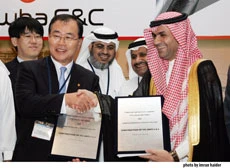
ALKHOBAR: Marafiq, the power and water utility company for Jubail and Yanbu, on Tuesday signed a SR2.7 billion ($720 million) contract with South Korea’s Hanwha engineering and construction company for setting up two steam-turbine generator plants in Yanbu.
The signing took place at Movenpick Alkhobar. Marafiq President and CEO Thamer S. Al-Sharhan and Hanwha President and CEO Kim Hyun-Chung signed the deal at a press conference in the hotel.
Al-Sharhan said the power generation units would be completed in 36 months.
“The first unit is to start commercial operation by May 2012 and the second is to be commissioned by July 2012,” he said.
The combined generation capacity of the two plants will be 500MW and will thus increase Marafiq’s present power output from 1,000 to 1,500MW.
Doosan, a world leader in power technology, will supply the boiler and turbine generator. The project will also include the supply and installation of 380 kV transformers and cables, 115 kV transformers and cables, MV and LV switchgear, control systems by Siemens, environmental regulation systems, fire control systems and all civil works required for the project. The power units will be environmentally friendly and will adhere to the environmental regulations of the Royal Commission for Jubail and Yanbu, said Al-Sharhan. Custodian of the Two Holy Mosques King Abdullah early this month approved the expansion project, which includes these two plants in Yanbu. The king was accompanied by the Chairman of the Marafiq Board of Directors Prince Saud ibn Abdullah Thunnayan Al-Saud, who said that the two plants would go a long way in fulfilling the requirements of upcoming industrial projects in Yanbu. The new generation plants will greatly enhance Marafiq’s capacity and will help meet the ever-growing utility demand of the industrial sector in Yanbu. According to Al-Sharhan, “Yanbu is developing, and it is developing fast, as is evident from the recent opening of several projects by the king in this thriving industrial community. The new generation plants will help Marafiq play a key role in all these projects.” Al-Sharhan said: “As a responsible private sector company we are doing everything possible to meet the national objectives of improving the efficiency of our economy and enhancing its competitive ability, engaging the private sector and international investors for investments. Our two new plants are a reflection of our relentless efforts in supporting the Kingdom’s industrial development strategies.”
According to Al-Sharhan, the project will lead to the creation of hundreds of indirect jobs for Saudis. “Projects of such scale will always have the employment scope for local people in an indirect way,” he told reporters.
Marafiq was established in October 2000 as a joint-stock company with four major shareholders — the Royal Commission for Jubail and Yanbu, Saudi Basic Industries Corp. (SABIC), Saudi Aramco, and the Public Investment Fund (PIF), each owning 24.81 percent share, while the remaining 0.76 percent are owned by seven private companies.
The company was set up to provide integrated utility services to industrial, commercial and residential customers in the two industrial cities of Jubail and Yanbu.
Marafiq started operating as a private power and water utility company on Jan. 1, 2003, with SR2.5 billion of initial owner equity and government assets transferred to the company.
In its five years of operation, Marafiq has emerged as a major force in the power and water sector in the Kingdom.