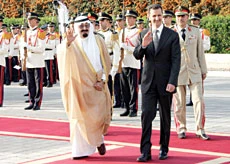
DAMASCUS: Custodian of the Two Holy Mosques King Abdullah began his landmark visit to Damascus on Wednesday opening a new era in Saudi-Syrian relations. President Bashar Assad honored the king by conferring on him the country’s top medal.
King Abdullah and President Assad held two rounds of talks at Ash-Shaab presidential palace. According to the Saudi Press Agency, the two leaders discussed major regional and international issues and ways of strengthening bilateral ties.
The first meeting attended by top officials from both sides saw Abdullah and Assad exchanging medals as the king received the Umayyad Order, the highest national honor in Syria. He reciprocated by giving King Abdul Aziz Medallion to Assad.
Saudi Arabia and Syria signed an agreement to avoid double taxation and prevent tax evasion. The finance ministers of the two countries signed the accord in the presence of King Abdullah and Assad.
Earlier, King Abdullah and his delegation were given a warm welcome at Damascus International Airport by Assad and top Syrian officials. The king was given a 21-gun salute at Ash-Shaab Palace grounds before inspecting a guard of honor.
This is Abdullah’s first visit to Damascus after becoming the king in August 2005. He is accompanied by senior Cabinet members and princes. The delegation includes intelligence chief Prince Muqrin, Labor Minister Ghazi Al-Gosaibi, Finance Minister Ibrahim Al-Assaf, Culture and Information Minister Abdul Aziz Khoja and State Minister for Foreign Affairs Nizar Madani.
Speaking about the taxation accord, Al-Assaf said it would reduce the tax burden on investors and ensure transparency in tax dealings. He urged businessmen in both countries to make use of the benefits offered by the agreement in order to establish more joint ventures. The volume of trade between Saudi Arabia and Syria jumped from SR1.18 billion in 2000 to more than SR4.58 billion in 2007.
Diplomats in Damascus said an understanding between the Saudi and Syrian leaders could help forge a wider Arab stance helpful to boosting Middle East peace, promoting formation of a new government in Lebanon and assuaging Arab fears on Iran, an ally of Syria.
“The two leaders have hot files on their hands. Palestine and the suffering of Gaza; Lebanon and its need for national unity; and Iraq,” said Syrian state newspaper Al-Thawra.
GCC Secretary-General Abdul Rahman Al-Attiyah said the Abdullah-Assad talks would strengthen Arab unity and solidarity, which is essential for Arab countries to confront the challenges surrounding them. “The king’s visit also reflects the GCC role in boosting joint Arab action.”
The Lebanese are looking at the Saudi-Syrian summit talks with great hope. Lebanese politician Ali Hassan Khalil said the Assad-Abdullah meeting would reflect positively in Lebanon, where prime minister-designate Saad Hariri has tried in vain to form a government since a parliamentary election in June.
“The resumption of ties will certainly help in pushing forward a domestic settlement over the (Lebanese) government,” Khalil told Reuters in Lebanon.
Political analysts have termed King Abdullah’s visit as highly significant as it reflects improving relations between the two major Arab countries.