
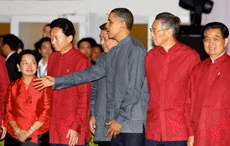
SINGAPORE: Asia Pacific leaders backed away on Saturday from supporting a global halving of greenhouse gas emissions by 2050, even as Brazil pledged deep cuts of its own over the next decade.
An initial draft leaders’ statement from an Asia Pacific Economic Cooperation (APEC) summit in Singapore had said that “global emissions will need to ... be reduced to 50 percent below 1990 levels by 2050.”
But a later, watered-down version stated: “We believe that global emissions will need to peak over the next few years, and be substantially reduced by 2050, recognizing that the timeframe for peaking will be longer in developing economies.”
APEC includes the top two greenhouse gas emitters — China and the United States — and its meeting is the last major gathering of global decision-makers before a UN climate summit in Copenhagen in three weeks, meant to ramp up efforts to fight climate change.
Its retreat may further dampen hopes that the Copenhagen meeting can yield a legally binding framework to stave off dangerous levels of global warming that scientists say threaten to bring rising seas and more droughts, heat waves and floods.
Arguments over targets have been a key stumbling block in UN negotiations and at other forums, such as the G8.
Meanwhile, US President Barack Obama raised hopes for creating an Asia-Pacific free-trade region by announcing Saturday that the US would seek to join a smaller group seen as a precursor to a broader Pacific Rim agreement.
News that the US would participate in the Trans-Pacific Partnership, joining Chile, New Zealand, Singapore and Brunei, was announced in Tokyo and Singapore, drawing applause at the APEC forum.
“Significant steps like the TPP are important to help keep up the momentum in our efforts to realize the ... vision” to create a region-wide free trade area, Singapore Prime Minister Lee Hsien Loong told other leaders at their weekend summit here.
There have been concerns that the US, the world’s biggest economy, and other nations might turn inward as they grapple with the worst global financial crisis in decades. Obama’s move reinforced calls for expanding free trade rather than resorting to protectionist measures to cope with the recession. He pushed for progress on talks to liberalize world trade.
“In this new era, opening other markets around the globe will be critical not just to America’s prosperity, but to the world’s,” Obama said in Tokyo before departing for the APEC forum.
APEC, celebrating its 20th anniversary this year, was created to promote greater trade and integration among Pacific Rim nations from Chile to China. Its scope since has expanded to encompass a wide range of issues, including climate change, energy and food security, and politics.
The anniversary comes amid the biggest global financial crisis since the 1930s. While the worst appears over, the recovery remains fragile, leaders said.
Trade has significantly contributed to growth in the Asia-Pacific region, but there are creeping signs of protectionism with the economic downturn, South Korean President Lee Myung-bak told his APEC partners.
“It is important that we leaders bear the firm belief that free trade is the way to contribute to national development, and we should prevent protectionism and spread free trade,” he said.