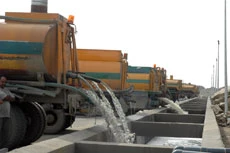
JEDDAH: The Jeddah municipality has banned any further dumping in Musk Lake as part of a plan to drain the sewage lake after reports that it could give way at any time.
The municipality has also decided to divert sewage trucks to a new treatment plant, which has a daily capacity of 60,000 cubic meters. The new plant began trial operations on Wednesday.
Ibrahim Kutubkhana, deputy mayor for construction and projects, said the municipality had begun a project to expand the sewage treatment plant near the lake. “The plant has advanced facilities with a three-tier treatment system,” he said, adding that its capacity had been increased from 30,000 to 60,000 cubic meters daily.
“With the opening of this treatment plant, no trucks will be allowed to dump sewage in the Musk Lake,” Kutubkhana said, adding that a facility to take water from 50 trucks at a time would be built near the plant, which will receive 3,700 trucks a day. In the beginning, the plant will have a daily for 250 trucks only, he said.
“We have placed cement barriers around the lake to prevent sewage trucks from dumping water there,” he said. The police have been instructed to divert trucks to the new sewage treatment plant.
Kutubkhana said the new plant would not receive industrial wastewater, as it would affect the plant’s system. “We have stopped dumping sewage in the lake since the Nov. 25 flooding,” he said, adding that the municipality has diverted sewage trucks to treatment plants in Ruwais, Hamra and Iskan areas.
“We have a plan to construct a container at the Ruwais plant to receive sewage brought by trucks,” the deputy mayor said. There will be a monitoring room at the plant to organize the dumping from trucks.
The treatment plant in Iskan currently receives 5,000 cubic meters of wastewater daily from trucks. The Hamra plant has a capacity of 50,000 cubic meters daily.
The municipality has set up a database for the sewage trucks. The drivers are given electronic cards to gain access to the treatment plants and dump sewage there.