
I can’t remember the last time I’d seen a bald eagle. Then last Sunday, I spotted two.
All eyes at the DuPont Environmental Education Center in Wilmington, Del., turned to the window as news of the eagles’ presence spread. “It’s a lucky day when you see those,” said Lesley Bensinger, the center’s education coordinator.
Bensinger and her staff are hoping for many more lucky days. More than a decade in the works, the environmental center opened to much fanfare two months ago on the 212-acre Russell W. Peterson Urban Wildlife Refuge. The four-story building along the Christina River overlooks a man-made marsh that is home to such creatures as snapping turtles and squirming mummichog minnows.
The center is the latest addition to Wilmington’s Riverfront, which 14 years ago was an industrial wasteland. The city, known best as home base for many of the nation’s biggest credit card companies, hopes that the Riverfront will someday rival Baltimore’s Harborplace or Boston’s Faneuil Hall Marketplace. Moderately priced and high-end restaurants have opened, and there are plans for a hotel. Up next: The spring opening of the Delaware Children’s Museum. Delaware may have been the first state, but it’s one of the last to have its own kids’ museum.
“It’s very important to get young people and families down here,” said Michael Purzycki, executive director of Riverfront Development of Delaware.
As a native New Yorker who has lived in Washington for many years, I had passed through Wilmington countless times on Amtrak or driving along Interstate 95. On my way back from New York last weekend, though, I decided to take a look. It was a sunny, mild winter day, perfect for a Riverfront walk.
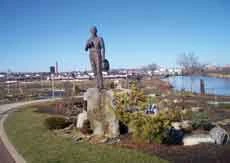
The first thing that caught my eye was the massive sky bridge that visitors cross to enter the third floor of the more than 13,000-square-foot facility. From the parking lot to the bridge, I walked through a garden with a waterfall, a tree sculpture, stone benches and a statue of Peterson, the former Delaware governor who had lobbied for the center.
Nancy DeLong, a teacher naturalist, led me around the building, which has interactive exhibits, labs and stunning views of the Wilmington skyline and the Christina River from its many observation decks.
From one of those decks, DeLong pointed out an osprey nest on a platform next to the Norfolk Southern railroad tracks. We walked down to the marsh, which is surrounded by a boardwalk. On the ground, DeLong pointed out the prints of white-tailed deer. Also recently spotted on the property: a red fox, raccoons, a great blue heron, a greater black-backed gull.
We ran into Linda and Kip Marsh, who live just outside Wilmington and thought that the center would be a good place for a Sunday afternoon stroll.
“It’s been a tough fight turning Wilmington from an industrial city to a tourist attraction,” Kip said.
“Philly did it in the ‘60s,” Linda said. “It takes time.”
The Riverfront has come a long way. Yes, there are remnants of what the waterfront used to be: Cranes once used to build ships still dot the landscape. But the two-mile stretch along the river is now home to the Delaware Center for the Contemporary Arts and the Delaware Theater Company. The Chase Center draws musical acts and art exhibits. Wilmington’s minor league baseball team, the Blue Rocks, plays at the Daniel S. Frawley Stadium. A river taxi lets passengers take in all the sights.
On this day, I opted to walk the two miles rather than take a taxi. After my tour of the environmental center, I stopped in at the Iron Hill Brewery for a snack and chatted with assistant general manager Michael Rivera. “Where we are now and where we were a couple of years ago is a quantum leap,” he said.
Continuing my stroll, I read the historical markers along the way, which told me, among other things, that several Underground Railroad stations had been identified in Wilmington.
I walked back to the Hotel du Pont, one of the most historic buildings in the city, admiring other historical landmarks. Before heading to Wilmington, I had talked to Doug Gelbert, author of the recently released book “Look Up, Delaware! 12 Walking Tours of Towns in the First State.”
“Everyone passes by Wilmington,” he told me. “It’s the stop on Amtrak or the hated toll road. No one really gets off I-95 to take a look around. What happens when you do is you see a city that has a wealth of architecture you would not expect for a city its size.”
That’s the thing about Wilmington. It’s not big or flashy. It constantly has to live up to comparisons with Philadelphia and Washington. But every once in a while, it surprises you with pockets of charm.