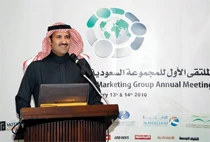
RIYADH: Leaders and managers of companies and publications of the Saudi Research and Marketing Group (SRMG) discussed the future of the print and electronic media at a recent two-day meeting.
They also looked at challenges facing the industry and outlined common roads that would lead to a new boom in the media and the means to benefit from it. The aim is to maintain the group’s position as the largest media group in the Middle East.
The group’s chairman, Prince Faisal bin Salman, stressed before the meeting that achieving integration and synchronization among all parts of the group was a vital need in its companies and publications and that it was necessary to consolidate it as a modus operandi that would benefit all.
The two-day meeting was held last Wednesday and Thursday and was attended by editors in chief, company managers and senior personnel in the group. “Reports about the dwindling numbers of newspaper and magazine readers are not accurate,” Prince Faisal said, adding that the number of readers in the region is larger at present than at any past time in the history of the print media. “It was only the tool that differed,” he said, citing as an example Asharq Al-Awsat newspaper whose readers have increased manifold since the 1990’s.
The meeting held open morning and evening sessions during which it discussed a number of working papers on the new trends in the media. The papers were presented by experts in the industry from abroad in addition to the executive directors and senior officials of the group. The participants were also told about the latest international expertise in media and management.
The first day
The meeting began with a brief speech by the chairman in which he welcomed the participants and said the meeting was aimed at enabling staff of the group to communicate and get to know each other rather than coming out with recommendations or resolutions. He considered this to be the first annual meeting although the group has previously held a number of meetings. The prince said the group planned to make the meeting an annual event so that all employees would share in the agenda and objectives formulated by the board of directors for the New Year and also to become acquainted with the hurdles and difficulties the group is facing.
Prince Faisal said it was not the intention of the meeting to produce a specific work plan but rather to inform the staff about the new decisions of the board of directors and other administrators with a view to synchronizing them.
“As members of the board of directors and shareholders, we are concerned with the final results of the activities of the group, meaning the realization of profits in addition to the other noble objectives the company and its publications are attempting to achieve. We want progress in every part of the group,” he said.
Referring to apprehensions about the future of the print media — which represents the crux of the work of the group — Prince Faisal discarded as “inaccurate” reports that said the number of newspaper and magazine readers was decreasing. Offering ideas for possible solutions, Prince Faisal said: “Harmonizing between the rise of readership and the size of revenues is important.
The balance between quality and cost is what we should aim for. The making of a quality magazine is not in itself a challenge. The real challenge is to produce the quality magazine at a lower cost.” Prince Faisal said the brainstorming that took place during the group’s meeting could produce new and additional solutions.
Newspaper industry
Change and development in the print industry were the subjects of the first day of the meeting. Chief Executive Officer of the Pacific Area Newspaper Publishers’ Association (PANPA) Mark Hollands analyzed the prospects facing the print industry in the coming decade and the changes and developments that might mark the nature, kinds and objectives of readers, especially in the light of constant developments in content. The evening session was “The Reality and Future of the Market in the Kingdom and the Challenges Facing Newspapers and Publications Which Depend On It For Income.”
The CEO of SRMG, Dr. Azzam Al-Dakheel, who spoke in the evening session, said a group the size of SRMG should be able to meet current challenges and should raise the scope of ambitions, regardless of circumstances. Al-Dakheel presided over the session which was addressed by the editors in chief of Asharq Al-Awsat, Tariq Alhomayed, and Al-Majalla, Adil Al-Traifi. “Being a pioneering company in our field, we should not be worried by a challenge. We have expert managerial and professional qualifications in all our companies and publications. It is a rare thing to see any group with this number of qualified staff,” he said. On the relationship between the editorial side and advertisement, Dr. Al-Dakheel said: “The group did not ignore to separate the commercial side from the editorial one. It has established a board of trustees which is fully undertaking its role.”
Addressing the meeting, Alhomayed said there were difficulties facing newspapers in the Arab market today. “A few years ago, there was a boom in the number of newspapers and magazines being published — in fact some companies and businesses began to issue their own private publications but since the financial crisis, this has more or less stopped.” He said: “There was a conflict between media and advertisement, a dividing line all must treat with caution. We have to develop new creative concepts and ideas. The group has made successful experiments in this connection including specialized supplements which gave the advertiser the right place at the right time and the right shape.”
In his comments, the editor in chief of Asharq Al-Awsat spoke about the significance of matching tasks with editor and advertising agent. “A high-quality news story is a means to attract both reader and advertiser,” he said. He added: “This may seem simple and easy at first sight but the media chaos that followed the introduction of new tools has limited competition to a narrow part of the targeted advertisers and editors.”
Commenting on this problem, Al-Dakheel said the threats posed by digital media, which might oblige newspapers to decide to remain as they are or change to electronic was subject for debate. He mentioned the decision of the group to make Al-Majalla magazine a digital publication after 30 years and said elementary indicators showed that it was a good step. The editor in chief of Al-Majalla said though the experiment was still new, it was reassuring. “The making of Al-Majalla into an electronic publication was a real challenge but the experiment revealed many beautiful things. We reissued the magazine depending on a limited number of reporters. We bought some material. We contracted some contributing writers despite the apprehensions of monopolizing a writer electronically in the Arab world,” he said.
Quality and budget
In the final session of the first day, Nik Rokoso, the chief operating officer (COO) for SRMG operations spoke about the balance between quality and budget, considering it the perfect means for achieving satisfactory results. “At the outset, the matter may seem difficult because quality also means more expenses. However, this could be done and there have been many experiments dealing with this,” he said.
Rokoso also spoke about the changes taking place in the region’s media and advertising sectors. “You should be happy. We are not the only ones being obliged to change,” he said jokingly. He then addressed the group’s plans to develop its print work, connecting it automatically to the digital world through various projects on the sites of electronic newspapers and magazines. He said some newspapers of the group had achieved excellent results in terms of spread and the number of visitors.
The second day
The second day began with a paper presented by the SRMG deputy CEO Tarik A. Algain who is also the managing director of the Saudi Research and Publishing Company (SRPC). He said the print media were facing a number of challenges at present in their sources of income. He stressed that there were huge developments which had created sharp competition to grab a share of readership and advertisement.
In his paper entitled “The SRMG: Present and Future,” Algain said technology was being used as new engines for income.
Specialized publishing
Muhammad Al-Omar, director general of the Saudi Specialized Publishing Company, an affiliate of the group, said the company was changing its name to “Numo Visual Media Company. He called for distinctions between a specialized publication and a general one because each has its own target audience. “They both have characteristics for competitiveness in readership and advertisement,” he explained. In his paper entitled “Industry of Specialized Publishing: Future Prospects,” Al-Omar said about 80 percent of the world’s top 100 publications were specialized ones. “The specialized publications have achieved great success and have become the most widely read, circulated and sold in the world.”
He cited the example of publications such as the Wall Street Journal and The Economist and said magazines represented a successful experience in the industry of the specialized media. Numo is one of the new projects of SMRG and in the final evening session of the second day, its CEO Fahd Al-Zughaibi said the company was concerned with diversified and developed TV transmission and added that the company had already made profits. He said the company was serving numbers of foreign and local TV channels in a number of areas, including modern studios, external transmission, production units, photography and control rooms. The meeting was shown a documentary film which dealt with the latest developments in both the print and electronic media. The film showed new aspects of the press industry, foremost of which was the linkage of content to modern technology.
For his part, Dr. Muhammad Ahmed Tahir, director of SRMG’s legal department spoke about strict punishment for violations in content which might go as far as withdrawing the publication and canceling it altogether. He recalled that according to international law, for violations newspapers would be directed to print apologies in the same space and in the same font. In his paper entitled “Causes of Media and Publishing: Laws and Practices,” Tahir called for discretion and for making sure of information before publishing it.
“It is the publisher, not the source of news, who will be held responsible in any media case,” he said. He warned that some media cases might reach the level of “criminal responsibility and legal violations” and said the punishment might snowball until it reached fines.
Challenges of distribution
Abdul Rahman Al-Mushawah, director general of the Saudi Distribution Company, an affiliate of the group, said distribution was facing grave challenges, not overlooking that books have much greater financial returns than media publications. In his paper entitled “Distribution in the Kingdom: Challenges and Prospects” Al-Mushawah pointed out that the proceeds made from distributing books might sometimes go up to 85 percent while the distribution of newspapers would be affected by the amount of competition and the rapid expiry of news.
Management of economies
In the last session of the meeting, Adil Al-Laithi, director of administrative and financial affairs in Asharq Al-Awsat in London, said the harmony between administrative and editorial teams was the most influential factor in any successful media activity. In his paper entitled “The Management of Successful Economies,” he highlighted the method of providing care for employees and creating communication between them and the directors of the various companies.
“The company has begun applying new protection procedures for employees in a number of departments. This will serve the staff and strengthen their loyalty to the group,” he said.
Open dialogue
The first meeting of the group wound up with an open dialogue with the chairman who said he was keen to listen to all candid and sincere viewpoints regarding the work of the group. He supported the suggestion that editors in chief hold quarterly meetings before the group’s annual meeting.