THE HAGUE: The International Criminal Court on Wednesday opened the possibility of Sudanese President Omar Hassan Bashir being charged with genocide in Darfur.
Appeals judges at the tribunal reversed a decision that prosecutors had not provided enough evidence to add genocide to Bashir’s charge sheet, ruling that the ICC’s pre-trial chamber must look again at whether he should face the charge.
“The decision by the pre-trial chamber not to issue a warrant in the respect of the charge of genocide was materially affected by an error of law,” ICC judge Erkki Kourula said in reading the appeal ruling.
Kourula said the appeals chamber would not grant the prosecutor’s request for a ruling that there were reasonable grounds to believe that Bashir acted with genocidal intent.
But legal observers said the decision to require the pre-trial chamber to review the genocide question brought the prospect of such a charge a step closer.
The ICC has no police force, however, and depends on national authorities and states that have signed up to the court to make arrests. It does not hold trials in absentia, so Bashir cannot be tried or convicted until his arrest.
A ruling on whether to add genocide to the list of charges will not take place quickly, but could take a few months.
Sudan said the ruling was political in its timing and aimed at hindering Sudan’s first democratic elections in 24 years, which are due to be held in April.
“This procedure of the ICC is only to stop the efforts of the Sudanese government toward elections and a peaceful exchange of power,” Rabie Abdelati, a senior Information Ministry official, told Reuters in Khartoum.
He said last year’s ICC arrest warrant for Bashir had not affected his movements or his nomination for the presidential elections and the latest ruling would be no different. He said Bashir was in Qatar on Wednesday.
Bashir has repeatedly dismissed the allegations made by the ICC, the world’s first permanent court for prosecuting war crimes, as part of a Western conspiracy.
US Assistant Secretary of State for African Affairs Johnnie Carson said in Ghana on Wednesday that Bashir should go to the ICC to face justice.
“We think that President Bashir should present himself to the court to face charges,” Carson told reporters.
ICC Chief Prosecutor Luis Moreno-Ocampo welcomed the decision and warned Bashir he needed to “get a lawyer,” adding he would present fresh evidence to the court in a second bid to have Bashir charged with genocide.
“Expelling humanitarian assistance is a great element of his genocidal intentions,” Moreno-Ocampo told Reuters.
“When he expelled these people who were providing the water and the food he confirmed his intention to destroy his people.
So I would like to present this new aspect of the case.” The arrest warrant against Bashir was the first ever issued against a sitting head of state by the ICC. It prompted Bashir to expel international aid agencies last year.
Darfur’s main rebel group welcomed the ICC’s decision, saying they would now reconsider taking part in peace talks.
“This is a correct decision,” said the chief negotiator for the Justice and Equality Movement (JEM) Ahmed Tugud. “We believe that what we have seen on the ground in Darfur amounts to a crime of genocide.” “Now we are assessing our situation on whether it is ethically possible to negotiate with a government accused of committing genocidal crimes against our people.” Tugud spoke from Doha, where JEM has been holding discussions with Khartoum supposed to lead to full peace talks.
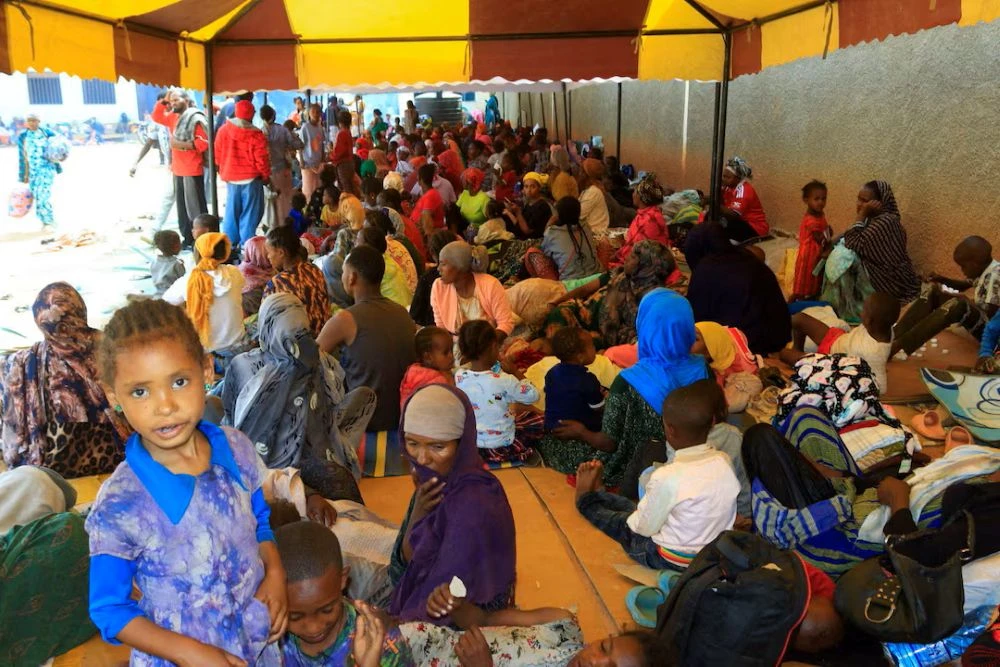
Adding a charge of genocide to the arrest warrant could further isolate Bashir, increase international pressure on him and provoke further unrest in Darfur, where 4.7 million people have been left dependent on aid by a seven-year conflict.
The Darfur investigation was launched in June 2005 after the UN Security Council referred the situation to the ICC.
In its ruling on Wednesday, the appeals chamber said the pre-trial chamber had placed too high a threshold on the evidence needed to include genocide in the arrest warrant.
Mostly non-Arab rebels took up arms in Darfur in 2003 accusing the central government of neglecting the remote region.
Khartoum mobilised militias to quell the revolt, sparking a humanitarian crisis which the United Nations estimates has claimed 300,000 lives. Bashir puts the death toll at 10,000.
Washington, Darfur rebels and activists all call Darfur’s conflict genocide. A UN-appointed commission of inquiry found no genocide, but said some individuals may have acted with genocidal intent.
(Additional reporting by Andrew Heavens and Opheera McDoom in Khartoum and Kwasi Kpodo in Accra; Editing by Giles Elgood)
REUTERS
Print ItemPrint Friendly View Linked Items Save 1-20100203-4126547-1.TXT Transfer Transactions Headline : 222 ams intw eurw glbh afr mid ^Genocide charge now possible for Sudan’s Al-Bashir ^Eds: RECASTS; UPDATES with detail, quotes.
^AP Photo LON101, BCZ104, BCZ102, BCZ106 ^By MIKE CORDER= ^Associated Press= THE HAGUE, Netherlands (AP) - The International Criminal Court was wrong when it decided that Sudan’s leader can’t be charged with genocide in Darfur, appeals judges said Wednesday - an unprecedented ruling that could lead to President Omar Al-Bashir’s indictment with humanity’s worst crime.
The appeals ruling also put other leaders around the world on notice that the court will not balk at charging them with genocide if they persecute their own people.
The standard of proof the court used last year to dismiss three counts of genocide against Al-Bashir “was higher and more demanding than what is required” in its statutes, appellate judge Erkki Kourula of Finland said Wednesday.
Activists welcomed the groundbreaking decision, which helps define just how much evidence prosecutors need before judges at the world’s first permanent war crimes tribunal will issue an indictment.
“Today’s ruling is hugely significant, as it could lead to the inclusion of charges of genocide by ICC judges for a sitting head of state and for the first time in the history of the court,” said William R. Pace of the Coalition for the ICC, a nongovernment group that supports the court.
The five-judge appeals chamber said the International Criminal Court wrongly concluded in March that there was insufficient evidence to charge Al-Bashir with three counts of genocide for allegedly attempting to wipe out entire ethnic groups in the war-ravaged province of Darfur.
Instead, the court charged him with seven counts of war crimes and crimes against humanity for allegedly orchestrating a campaign of murder, torture, rape and forced expulsions in Darfur.
Al-Bashir, the first sitting head of state indicted by the world’s first permanent war crimes tribunal, refuses to recognize the court’s jurisdiction and has vowed never to surrender.
Rabie Abdel-Attie, a Sudan government spokesman, said the decision Wednesday reflected its increasing isolation from reality on the ground in Sudan. He said the decision will not affect Al-Bashir’s bid to run again for presidency at elections expected in April.
“The government doesn’t give the court any consideration and doesn’t care much for it. This is a matter of principle,” he told The Associated Press from Khartoum.
“The court is heading in one direction and we in the other.” Al-Bashir’s indictment in March further isolated his hard-line regime. Since the charges were issued, the Sudanese leader has traveled to friendly countries but called off trips to nations where he fears he could be arrested and sent to The Hague.
His government expelled 13 international aid agencies working in Darfur in response to the charges, further compounding the humanitarian crisis in a region where 300,000 people have died since fighting broke out in 2003 between the government and rebels. The United Nations says 2.7 million people have been driven from their homes.
Prosecutor Luis Moreno Ocampo said the decision to expel aid agencies bolsters his genocide case against Al-Bashir.
“For me, the fact that President Bashir expelled the humanitarian organizations is confirming that his intention is the physical destruction of these people,” he told The Associated Press.
He accused Al-Bashir of keeping 2.5 million refugees “under genocide conditions, like a gigantic Auschwitz.” Moreno Ocampo accuses Al-Bashir of mobilizing the entire Sudanese state apparatus with the aim of destroying a substantial part of the Fur, Masalit and Zaghawa ethnic groups in Darfur over more than six years.
Prosecutors accuse Sudanese troops and the janjaweed Arab militia they support of murdering civilians and preying on them in refugee camps. Moreno Ocampo said part of the alleged genocide was a campaign of rape to drive women into the desert, where they die of starvation.
Analysts said March’s decision was vital in laying the groundwork for potential indictments of other leaders who have been mentioned as possible targets of war crimes investigations as it rejected head of state immunity protections.