
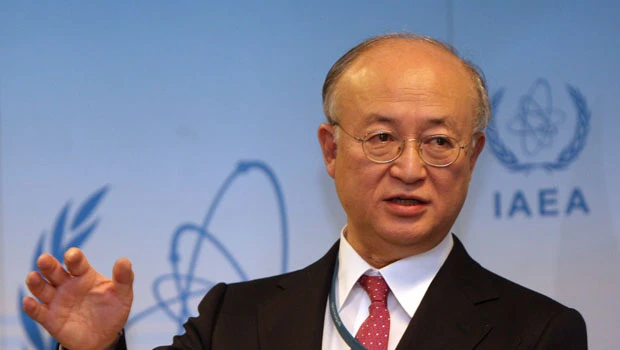
- VIENNA: The new UN nuclear agency chief said on Monday his report Iran could be trying to develop a nuclear-armed missile was factual and impartial, rejecting Iranian suggestions he was biased toward Western powers.
Yukiya Amano spelled out a "clear" approach to Iran's nuclear activity after what diplomats said was the reluctance of his predecessor Mohamed El-Baradei to confront Iran due to his skepticism about the veracity of Western intelligence on Tehran.
In an address to the International Atomic Energy Agency board of governors, Amano said: "We cannot confirm that all nuclear material in Iran is in peaceful activities because Iran has not provided the agency with the necessary cooperation."
Iran protested and at a later news conference, Amano sought to clarify his comments.
"Yes, there is cooperation from Iran. That is why we have been able to confirm that declared nuclear material has not been diverted for non-peaceful purposes. But there areas where we don't have cooperation and (where) we need cooperation," he said.
Iran must implement resolutions of the IAEA board and the UN Security Council to cease uranium enrichment, the Japanese diplomat added.
At a press conference in Geneva, Iranian Foreign Minister Manouchehr Mottaki said his country was fully cooperating with the IAEA.
"The new chief and the new managers of the agency should look at the record of Iran's cooperation," Mottaki said. If they had "a very brief look at Iran's record, they would understand that we have a full cooperation with the agency and these cooperations will continue."
Amano, who took over the UN watchdog on Dec. 1, circulated a report to IAEA member states 10 days ago which was seen as using tougher language than his predecessor.
Amano expressed concern that Tehran may be working on a nuclear warhead and confirmed that Iran has started enriching uranium to higher levels, theoretically bringing it close to levels needed for an atomic bomb.
Speaking to reporters after Amano's speech, Tehran's envoy to the IAEA, Ali Asghar Soltanieh, called the report "unjustified and not acceptable."
Amano's blunter line on Iran could be significant if it increases momentum toward harsher UN sanctions on Iran. Six world powers have begun deliberations on more sanctions at UN Security Council level in New York.
"In my view, this report is factual and absolutely impartial. That is the essence ... it took stock of the whole picture. I wanted the report to be clear, straightforward, easy to read and understand," Amano told reporters.
He said intelligence information that hardened the IAEA's disquiet about possible nuclear weapons-relevant activity in Iran was collected from multiple sources and was consistent in detail, timeline, and Iranian officials and agencies cited.
"We have an integrated team of experts, we have experience.
And the information is extensive. We cross-check it. After this process, we are saying that altogether it raises concern."
Asked to address Iranian accusations of bias, he said: "My report does not say that Iran (indisputably) has or had a nuclear weapons program. I want to make that clear. We have chosen our words carefully," Amano said.
He said it was urgent for Iran to dispel suspicions by suspending nuclear fuel production, allowing unfettered UN inspections and opening up to IAEA investigators.
Iran denies ever seeking nuclear bomb capability, saying its uranium enrichment drive is only for peaceful energy purposes.