
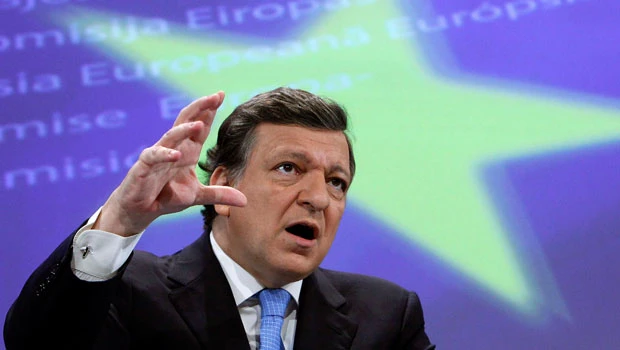
- BRUSSELS: The European Union will more tightly regulate the economies of its 27 members to safeguard the stability of nations using the euro currency and fend off threats like Greece's debt crisis, the commission president said Wednesday.
EU Commission President Jose Manuel Barroso said the new measures would generate warnings if one country was heading off track, which might have flagged Greece's soaring debt problem at an earlier stage.
"The European Union appears ready for stronger economic coordination and stronger economic governance," he told reporters. "The financial crisis has highlighted our interdependence, the fiscal crisis in some of our member states has highlighted the consequences some mistakes made in one country may have on other countries. It's much clearer now, the need to act together," Barroso said.
Markets fear that Greece could default on its heavy borrowings because it faces low growth in coming years and high public spending - which the government is now trying to curb. Greek Prime Minister George Papandreou announced more painful budget cuts Wednesday that officials say will save the country an 4.8 billion euros ($6.5 billion). Euro zone governments have been reluctant to say how they might fulfill a promise to rescue Greece if needed. Athens says it does not need a bailout.
Barroso said there is "intense debate" on how a potential bailout would work and details would be announced when a final decision was made. He did not say when the tighter regulations would be announced. "The concrete instruments, we will present them in due time," he told reporters. "We have to have solidarity in the European Union."
Barroso also called for stronger economic governance in the EU, saying there is a "real sense of urgency" for European governments to boost growth and smooth out major differences between their economies. He is asking EU leaders to back his economic strategy for the next 10 years at a March 25-26 summit and said he was confident that governments would drop previous objections over giving the EU more say in how they run their economies. The European economy's ability to expand has been damaged by the economic crisis, he said, and governments need to take tough measures if they want to avoid sluggish growth that would make it harder for them to fund generous social welfare systems. He said the EU should monitor economic performance in each member nation and set targets for how each could improve their ability to grow. He also wants open up the services sector to allow companies to work more easily in any EU nation.
Barroso said there is a need to rebalance demand across EU countries - a prod for Germany and the Netherlands to stoke spending at home. But he said there would be no sanctions for countries that aren't hitting their targets - which could weaken the force of any EU warning.
Barroso wants to set five overall targets for EU countries by 2020:
- to boost employment from an average of 69 percent to 75 percent of all Europeans aged 20-64;
- to increase how many young people gain a college degree from 30 percent to 40 percent;
- to increase research spending by governments and companies to 3 percent of gross domestic product;
- to reduce the number of people living in poverty from 80 million to 60 million;
- to generate more renewable power and reduce energy consumption as part of the EU's ambition to slash greenhouse gas emissions by 2020.
Meanwhile, Italian President Giorgio Napolitano called on Wednesday for the creation of a European
monetary fund to help euro zone nations in trouble.
"The European Central Bank (and) the European institutions are aware that there's something missing from our common tool box to tackle unforeseen and serious crises in one of the euro zone nations," Napolitano told a press conference at the European Commission in Brussels.
Asked whether he saw a need for a European, rather than international, monetary fund he replied that the current Greek crisis "demonstrates the need for such an instrument to prevent and deal with such crises." Napolitano added that membership of the 16-nation euro zone brings with it "an obligation for (fiscal) discipline."
The idea of a European fund set up to support euro zone nations has previously been advanced by some economists and political figures.
European Socialists on Tuesday called for the creation of a such a fund, which they said should be managed by the European Investment Bank (EIB), to help Greece and others ward off speculators as they tackle budget crises.
Under their scheme the EIB, Europe's lending arm, would borrow from the market at a reasonable interest rate. Countries in crisis could then borrow these funds at a similar rate as others are able to do, the Socialists said in a statement.
Such a system would protect the euro zone against speculative attacks on sovereign debt and create conditions in which a sovereign default by any euro zone member state "is clearly judged impossible by the markets," the European Socialists said.
The European Commission says it will call in market regulators and banks to discuss possible problems with the market for credit default swaps on sovereign debt.
The swaps are a form of insurance against a borrower defaulting on debt - and the market for them has swelled in recent weeks as traders weigh up the risk that Greece might not be able to repay its massive debt.
EU Press Officer Carmel Dunne said Wednesday in an e-mailed statement that EU officials were looking at the
issue closely and would shortly call a meeting of regulators, supervisors and the industry to discuss it.
The Wall Street Journal reported Wednesday that the US Department of Justice is investigating whether hedge funds banded together to drive down the value of the euro against the US dollar.