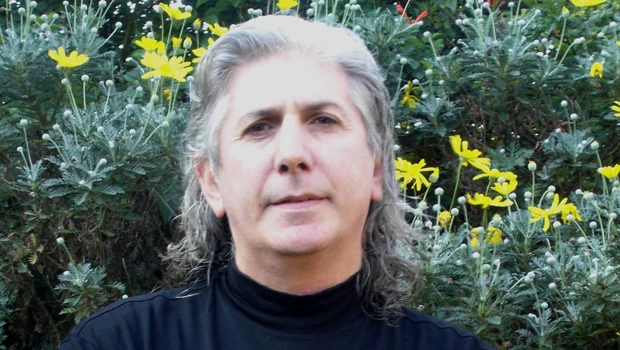
- Australian artist, Konstantin Dimopoulos’ work focuses mainly on social art.
- He tries to give visualization to ideas he holds close to his heart — namely, the environment and social issues.
He began to work on sculptures and installations more than a decade ago. In 2001 he created “Pacific Grass,” a beautiful wind sculpture which he gave to the city of Wellington, New Zealand, where he earned his art degree. Since then he has gone on to create his signature rod sculptures that are in public and private collections in Australia, the United States, Europe and New Zealand. Geometric forms, optical dynamics, color and the relationship to space are all important aspects of his work.
Dimopoulos is currently in Abu Dhabi to participate in ADISS (Abu Dhabi International Sculpture Symposium) where he can be seen in action at the Armed Forces Officers Club. Here he is in conversation with Gargee Chakravarty.
Why are you an artist, and when did you first become one?
It is what I have always wanted to be. I come from a family of master tailors and have always been around creative people. Also, I was born in Egypt and did not leave the country until I was eight years old so my early years were spent in a vibrant, very colorful community. I started working as a full time artist in the 1980s, working at that time in paintings and sculpture, then moving over time into public gallery installations.
Where did you acquire your art design knowledge and skills?
I think you learn by being open to the world around you and by looking at other artists’ works. You then begin to focus on your own inner voice and start moving towards ideas that interest you. Some skills you learn through formal education; others you learn by trial and error until you achieve what you feel is the essence of your creativity. My work of the last decade has inclined towards explorative work; from this explorative platform I have moved into kinetic work. It is the characteristics and variations that different materials have in relation to what moves them that interest me. How form changes through movement and the part that stillness plays in the work “the pause.”
Could you tell us some more about your sculpture? How would you describe your style in your own words?
I have two streams to my art — the first are my sculptures. While I continue to create the sculpture that defines me using color, line, form and repetition, I am also now creating works that are monumental in their scale. The second stream to my art practice is my public installations. These are ephemeral works along global themes such as deforestation, cultural appropriation and migration. With these I have returned to the idea of creating works that have a social outcome — social art.
Talk to us about your sculpting technique. What are the materials that you prefer?
For the last decade I have been using high-performance composites rods. I see space as linear and my rod sculptures define the spaces they inhabit. However, as an artist I feel it’s important to continue to explore new forms and materials and some of my recent works have been made from steel to enable me to create the shape and monumental scale I want and envision.
Do your works share a common theme?
No. My sculptures always relate to their site and wider environment. My public art actions reflect different social themes.
What influences have driven your technique?
Only creative ideas. Materials and techniques are just a means of realizing these ideas.
Do you plan the way things are going to look ahead of time or form them as you go?
I plan as I go. I think the work is more spontaneous that way and not forced. Each artwork I create is unique and created specifically for the site in which it will be installed.
What famous artists have influenced you, and how?
Jesus Rafael Soto, Mark Rothko, Joseph Beuys and Alexander Calder.
How do you see the role of art in public space?
Public art defines space. It creates a visual identity, which in turn defines a community. It says that aesthetics, art and dialogue are important to the people who make up that community. Art is not just pure art. It is also architecture, gardens, and landscape design, industrial design. Take out all of this and see what you are left with. Just as humans have a soul, so art creates the soul of a city.
What other interests do you have outside of creating art?
I am always creating art so there is no ‘outside of this’. Art exists in my head all of the time. However, I have a family and they are the center of my life. They keep me grounded.
How do you keep motivated when things get tough in the studio?
I have been a professional artist for many years now, so this is not an issue. However, in the earlier days I retained a focus for achieving my vision of earning a living from my art and this kept me positive and moving forward.
What role do awards and recognition play for art and for you?
I think that artists want to have their work recognized. The art we create is like our children and we want everyone to tell us how beautiful our children are. Awards are fine — but not an end in themselves. It is what you do with your career after winning awards that is important.
What have been the favorite projects to date in your career, and why?
I have enjoyed all of my projects over the years. What I really enjoy about my work is the people I meet and the teamwork that goes into creating a work. I like working with others as so much of the creative process is done in isolation.
How would your life change if you were no longer allowed to create art?
That, to me, is like trying to comprehend infinity.
What advice would you give to an artist just starting out?
Know who you are. Create works that define you so that you can speak easily about them. Have a vision and work towards it. I always wanted to be a practicing artist. But I know other artists who also enjoy teaching art and creating works around this commitment.