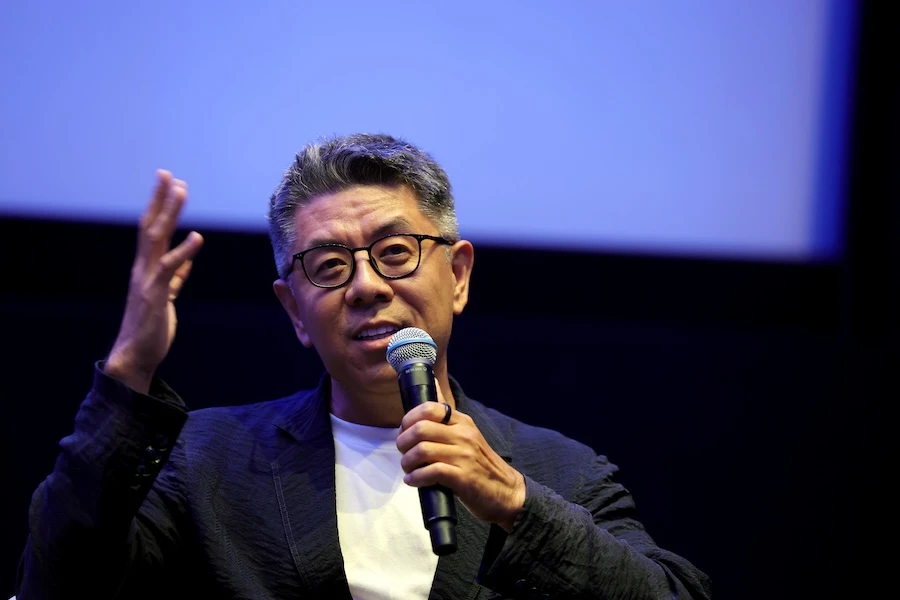
DUBAI: For Chinese architect Ma Yansong, the founder of MAD Architects — a global design practice with offices in Los Angeles, Rome, and Beijing — and one of TIME magazine’s 100 Most Influential People of 2025, the future of architecture is not about building taller skyscrapers or more technologically advanced cities; it is about creating spaces that make people feel something.
“The box is the idea that a city is a machine. Modernism gave us that: A building is a box for working, a city is a grid of boxes, and the measure of success is how efficiently people move through them. It worked. It also made every city in the world look the same,” Ma told Arab News.
“The box I’d most like architects to leave is the belief that this is the only serious way to build. We’ve taught ourselves that emotion is decoration and efficiency is truth. But a city isn’t a machine. It’s where people fall in love, raise children, grow old. If it gives them nothing to feel, it has failed, no matter how well it works.”
Ma is in Dubai to deliver a TED Talk titled “Why We Need to Think Outside the Box” at the Museum of the Future on Nov. 18, as part of Dubai Future Week.
Having spent more than two decades challenging conventional architectural thinking, Ma believes the next frontier for cities such as Dubai lies not in their skylines, but in the experiences they offer at ground level.
“What I admire about Dubai is that it decided to imagine its future and then built it, in one generation. Very few cities have had that courage,” he said.
“The first chapter was about height and about being seen. I think the next one is about how a person feels inside the city: shade, walking, the space between buildings, somewhere to be quiet.”
He pointed to Dubai’s 2040 Urban Master Plan, which aims to double the city’s green and recreational space, as an indication of that changing ambition.
“Dubai is already moving this way. Its 2040 plan sets out to double the city’s green and recreational space. It has the will and the means, and I think its next innovation could be nature and emotion designed into the city with the same ambition that built the skyline.”
For Ma, this philosophy is already evident in MAD Architects’ projects around the world.
At the Lucas Museum of Narrative Art in Los Angeles, the building was elevated to transform a former parking lot into a public park. At the Harbin Opera House in China, visitors can climb the building’s roof like a hill, regardless of whether they are attending a performance. In Jiaxing, a train station was moved underground to make way for a forest park.
“None of these is decoration. They are what people remember, and I think a building that isn’t remembered hasn’t finished its job,” he said.
Central to his philosophy is the idea of an “organic city,” where buildings, streets and public spaces form a continuous landscape rather than existing as isolated structures.
“A city that grows the way a landscape does, where buildings, parks and streets are one continuous thing and you can’t quite say where one ends,” he explained.
“For an ordinary resident it shows up in small things. You cut through a park on the way to work. You stop in the shade because there is somewhere to stop. Nobody has told you what that space is for.”
Rather than filling every available plot, Ma argues that architects must recognize the importance of leaving room for spontaneous human activity: “A city needs blank space the way a painting does. The rest isn’t designed. When architecture holds back, what people do becomes the main thing, and activity grows there on its own.”
The philosophy has particular relevance for the Middle East, where extreme summer temperatures often dictate how residents interact with their cities.
Having travelled through the region to study its landmarks, public buildings and urban spaces, Ma believes cities such as Dubai, Riyadh and Doha should look to their own environments and architectural traditions rather than replicate Western urban planning models.
“Many people think nature means green. But the desert is nature. The sea is nature. So are extreme heat and hard winters,” he said.
“If that is true, then a building’s relationship with nature can’t be a lawn outside the window. It has to start from the place itself: Its climate, its materials, even its ideas and strategies for building should be local, and the signature buildings come from there, instead of just use symbols and decorations.”
He highlighted traditional regional architectural features, including wind towers, courtyards, thick walls and narrow shaded lanes, as examples of how generations of builders have adapted to challenging climates.
“I think the answer is to join heritage with today’s engineering and technology,” he said.
“Architecture here can grow its own DNA out of that tradition and culture, carried forward by technology, instead of only applying symbols and decoration. I’d love to see what that future looks like.”