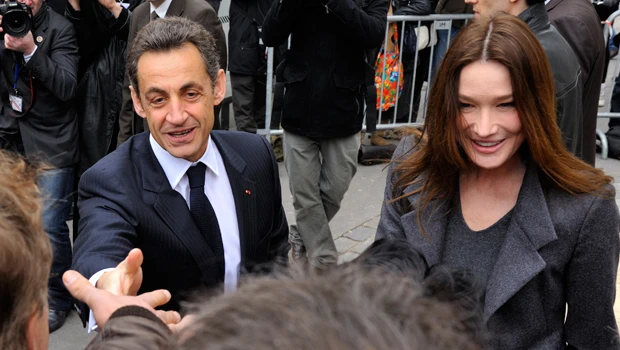
- PARIS: President Nicolas Sarkozy will find it harder to win support for his plans to reform pensions and rein in France's yawning budget deficit following a heavy defeat for his center-right party in regional elections.
The opposition Socialists came out well ahead of Sarkozy's UMP in the first round of the regional ballot on Sunday, pointing to a significant defeat for the president's party in the decisive second-round runoff on March 21.
The regional councils, responsible for issues like school buildings or local transport, have little economic power and play no role in national government.
But the result, the last major ballot before Sarkozy seeks re-election in the 2012 presidential vote, is likely to embolden unions that oppose his reform agenda, making it more difficult for the government to claim broad backing for its plans.
"It's a pretty massive result. This is not the kind of result you get all the time. It's a mini-landslide," said Paul Bacot, a professor at the Sciences Po political science institute in the French city of Lyon.
With the pension system facing a steadily widening funding gap that is expected to climb to 14.5 billion euros ($19.93 billion) by 2013, Sarkozy has pledged an overhaul that is likely to raise retirement ages, a clear target for the opposition.
He must also squeeze spending significantly if he is to fulfil a pledge to his European partners of bringing the public deficit down from 8.2 percent of gross domestic product this year to below the European Union ceiling of 3 percent by 2013.
The government had already shown itself to be extremely sensitive to protests over factory closures and Sarkozy has ruled out cutting pensions or raising taxes, stressing the role of France's broad social protection network in the crisis.
The defeat in the regional vote could further reinforce the government's caution as Sarkozy gears up for what could be a much tougher election campaign than the one he experienced in 2007.
The Socialists have struggled since Sarkozy won power, but party chief Martine Aubry has restored confidence after taking the leadership in 2008 and the left has profited from discontent over issues ranging from jobs to immigration.
Left wing groups grabbed around 50 percent of the first round regional vote, with the Socialists alone taking just over 29 percent, ahead of 26 percent for the UMP, which was hard hit by the fact that more than half the electorate stayed at home.
Adding to worries for the UMP, the far-right National Front bounced back from a string of recent failures to win almost 12 percent support, meaning they will siphon off part the broader conservative vote in the crucial second round.
"This vote shows a clear rejection of the policies that have been followed," the powerful CGT union said in a statement after the first round vote, announcing a "day of action" on March 23 to back demands on pay and pensions.
A steady stream of protests and strikes in recent months by groups ranging from teachers, police, judges and post office staff to oil refinery operators, car parts suppliers or airline staff have underlined a deep mood of discontent in France.
The euro zone's second largest economy has weathered the financial crisis in better shape than many of its neighbors but even so, unemployment is over 10 percent, public finances are under strain and recovery is expected to be slow and bumpy.
"The labor relations climate at the moment is a delicate one for the government and very uncertain from the point of view of French society," said Bernard Vivier, head of the Institut Superieur du Travail, a labor relations think tank.
Sarkozy has ruled out any major cabinet reshuffle after the regional poll, but the expected defeat of all eight ministers who ran in the elections has underlined growing doubts about the ability of the government to push through big changes.
To make matters worse, the UMP's fomerly rock-solid discipline has frayed and potential center-right opponents to Sarkozy, such as Jean-Francois Cope, head of the UMP parliamentary group, have come increasingly into the open.
While the implications for the next presidential election are unclear - the Socialists won the last regional poll in 2004 decisively, but went on to lose heavily to Sarkozy three years later - the likelihood of radical new reforms seems slight.
In an interview with the Le Figaro daily last week, Sarkozy had already signalled that he would slow the pace of reform next year, a marked shift in tone for a leader who came to power three years ago pledging profound and lasting change.