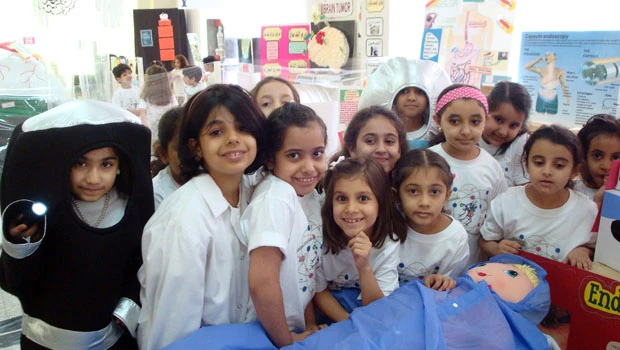
- ALKHOBAR: Medical diagnostics was the theme of the Bayan Gardens School (BGS) math and science exhibit.
In past the school used its annual science fair, called “Diagnostics@BGS 2010” this year, to educate its students and the community about disease prevention and control.
But this year the focus was on the technologies that are available and being developed to diagnose illnesses.
Alongside traditional diagnostic equipment, students learned about nanotechnology, biotechnology and virtual autopsy.
“Our goal this year was to show how math and science come together to create medical technologies that diagnose illnesses earlier or in less invasive ways,” said BGS Director Yasmeen Husain.
“Biotechnology and nanotechnology also have the potential to change how we treat illnesses, since even the underlying circumstances for a disease can be discovered before it has caused any damage to an individual’s health. Our older students also explored virtual autopsy technology, which is being used in criminal forensics as well as medicine.”
Over 570 students took part in Diagnostics@BGS 2010. The students created real and virtual models of the technologies they were investigating.
They went on field trips to local hospitals to learn about diagnostic equipment firsthand and were able to watch it in action.
For example, one group of girls was able to see the image of an unborn child in its mother’s womb using ultrasound technology.
The students also had the opportunity to understand the potential of upcoming technologies such as nanorobots, nanotubes and quantum dots.
“We want to thank the Eastern Province medical community who were so supportive of our educational efforts this year,” Husain said.
“We were also thrilled to host a large delegation from the Ministry of Education. We hope that our students and their families will spread the message that early diagnoses can lead to positive outcomes in the treatment of many illnesses.”
Area medical centers that welcomed BGS students during the preparation phase of the fair included Saudi Aramco Medical Services Organization, Mohammed Al-Dossary Hospital, Procare Riaya Hospital, Saad Specialist Hospital and the King Fahd Hospital, which is part of the university of the same name.
The Civil Defense brought an ambulance to the school compound so students could learn about the equipment paramedics use in emergency cases.
The students were very enthusiastic in understanding how schoolroom learning could be useful in real life situations.
Eighth grader Na’ima Al-Habbas explained that they had studied the human heart in biology class.
They then combined that knowledge with the additional information they gained through understanding how angioplasty is used to diagnose various heart conditions.
“I understand more now about the functioning of the heart and cardiovascular system” she said.
“I plan to watch what I eat so I don’t ever need an angioplasty or suffer from heart disease.”
The students’ parents were fully supportive of the school’s program, including the concept that culturally sensitive diagnostic tests such as a mammography should be discussed openly.
“The math and science fair is a wonderful chance for our kids to learn while enjoying themselves,” said Maha Bakr, a mother of two BGS students.
“Look at how excited these kids are to learn. Since the beginning of the semester the students have researched their topics on the Internet. They’ve written reports about the knowledge they’ve gained. They’ve helped to create all the exhibits here. Now they’re presenting all this information to the visitors today. This is a complete learning process focusing on important ideas in health and technology. It’s amazing.”