- DAMMAM: The Eastern Province was in the eye of a severe sandstorm on Saturday that led to airline delays, minor accidents and traffic jams.
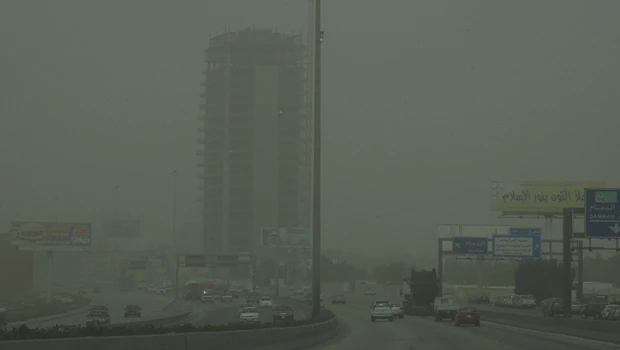
Visibility in all the major cities of the region, including Dammam, Alkhobar, Al-Ahsa, Jubail, Hafr Al-Batin and Al-Khafji, was reduced to between 300 and 500 meters.
The storm started blanketing the region at 7 a.m. as sand-laden winds exceeding 25 mph made life difficult for motorists who drove with hazard lights on as they negotiated their way through the thick balls of yellow and orange dust.
Traffic police reported a number of accidents on the highways crisscrossing the province but reported no serious cases.
At the King Fahd International Airport, some airline pilots reported difficulty in landing and takeoff. Many planes had to circle over the airport several times throughout the morning and afternoon to get a clear view of the runways.
“Yes, the visibility was very, very low,” said Mohammad Ehab, official weather forecaster at the airport. “And winds, which literally carried mounds of sands in their wake, made things even more difficult.”
Ehab said sandstorms are generally expected at this time of the year. “We are in the beginning of spring, and usually such changes in the weather pattern induce sandstorms,” he said, predicting the region would likely see more sandstorms during the course of the next 10 days.
He said the sandstorm originated in the Kingdom’s north. “This one did not originate in northwestern Iraq as was the case with a major sandstorm in the Eastern Province in July 2009.”
Ehab said the storm was still raging at 4 p.m. when he was speaking to Arab News.
He expected it to subside “only after 8 p.m.”
Pakistani business executive Marwan Quraishy, who flew in from Jeddah on the 8 a.m. NasAir flight, said as the plane began its descent one could notice the impact of the sandstorm on the city below.
“Everything was covered in a thick layer of dust ... I couldn’t see the city’s major landmarks while approaching terra firma,” he said. “As we got off the plane we could breathe nothing but fine dust. I instantly began sneezing.”
According to him, the distance from the airport to his workplace in Dammam took him more than two hours because of poor visibility on the roads. “This is the distance that would usually take me less than 30 minutes,” he said. “We just could not see across the street.”
Quraishy said that at one point it had begun to drizzle as well, making driving even more hazardous. “I saw at least three or four accidents on the way back from the airport.”
For Egyptian teacher Amina Abedin, the storm brought nothing but distress for her nine-year-old son.
“Our house in Al-Raka district is not dust proof, and so when the storm started hitting our area I could feel and actually smell sand in our home. Since my son is asthmatic, I tried to protect him, but it was too late, and I had to take him to a hospital. He had acute breathing difficulties,” she said from her son’s hospital bed in Astoon Hospital. “This weather is very depressing.”
At the Kingdom’s main crude export terminal in Ras Tanura, the weather was no different. One official said it had no impact on the flow of oil. “The export flow was uninterrupted, and the loading and shipping went on smoothly.”