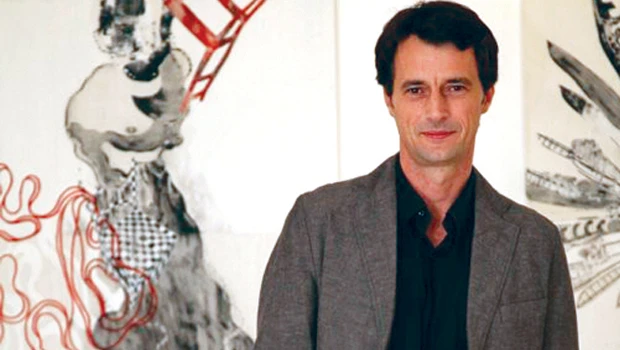
- An artist caught in a sphere of guilt with a thirst for space in a concrete jungle and a sense of spirituality in the midst of a remote African tribe — these are some of the profound realizations that have molded and shaped the way Baudouin Tasle d’Heliand looks at art today.
- D’Heliand (nicknamed Bo) is indeed a unique human being.
His most recent exhibition titled “Birds Eye Vision Inside-Out,” which was held in Salwa Zeidan Gallery in Abu Dhabi, evoked a lot of interest and curiosity. This one-month long exhibition features more than 15 works made with China ink and flour glue on recycled paper. The exhibition also features some of his latest metal and paper sculptures.
The strange way the subjects are shown on the canvas sets D’Heliand’s paintings apart from a general work of art. The viewer gets the feeling of looking at the objects in the painting from a distance high above the ground, as though it is seen by a flying bird. His paintings, titled “Eagle’s eye vision,” gives an uncomplicated and borderless vision of things down below.
“I came upon this concept in search of space and in an effort to bridge two cultures,” says d’Heiland. He traveled to northern Kenya to a place called Rift Valley where he spent some months with the Turkina tribe.
His European background perhaps contributed a little toward the guilt he felt at the way this small tribe had been neglected by the rest of the world. His love and compassion for these people drove him to draw them in life-sized scale using a bird’s eye view. Because it was the first time he uses this kind of style and perspective, he climbed trees to see the land from above and accurately portray it.
D’Heiland believes in animism or the belief in the existence of individual spirits that inhabit natural objects and phenomena. “The concept began in Africa thanks to the animistic stories that the old of the tribe told me. I have now accepted the spiritual side of my work,” he declares.
However, d’Heiland didn’t always live among tribes nor did he start off with the idea of becoming “nothing but an artist.” It is quite the contrary. He actually hails from an aristocratic family in France and was raised in a very traditional way. His initiation into art began when he learnt to walk as he accompanied his mother to numerous museums. He believes he learned to respect “creation” after watching his mother restore and bring life to old paintings.
After completing his baccalauréat (France’s national seconadary school diploma), he studied economics at the University of Paris and later entered the National School of Decorative Art in Paris. He then completed his Master’s degree in communication at La Sorbonne. “This double education has opened a lot of opportunities for me but has also made choosing a career more difficult,” says d’Heiland.
He certainly has had a wide range of career opportunities — ranging from set design, costume design, graphic design, art direction to installations and paintings. His resume describes him as an Art Strategist and he’s had the distinction of working with television media groups, national operas and dance companies with the same ease.
Evidence of d’Heiland love of art comes from the man himself: “I fell in love with dance when I was living in Scandinavia. I was the cultural attaché (specialist in cultural matters) for the French embassy at that time. There, I saw “Giselle”— the first ballet I had ever seen,” he says.
“Even though it was classical, it convinced me to involve myself in a world of dance. As a result, I decided to contact the head of the opera of Finland. After seeing my art exhibition in a Finnish gallery, he proposed that I collaborate with him on three Stravinsky creations: Petrushka, Firebird and the Sacre du Printemps (Rite of Spring). Working day and night in an Opera production, collaborating with dancers, musicians and decoration workers was a dream. I think the premiere of Petrushka was the high point in my life.”
D’Heiland’s intense innovative techniques have helped him invent and create his artwork. “I’m interested in every field that could need creativity,” he explains. “Almost all the time, I discover new fields through people I meet. This year, as an artistic director, I collaborated with landscape design agencies and event organizers.”
Currently d’Heiland works from a studio in Dubai and is enjoying meeting artists with different sensibilities, approaches and styles. He believes that in the future, art will use more and more de-materialized media and will depend more on interactivity and social networks. He believes the content will remain the same, however.
“I don’t believe in art history but in human’s vital need to express and feel art,” he says. Going by the interest an art exhibition generates, it is catching up fast with the rest of the world.