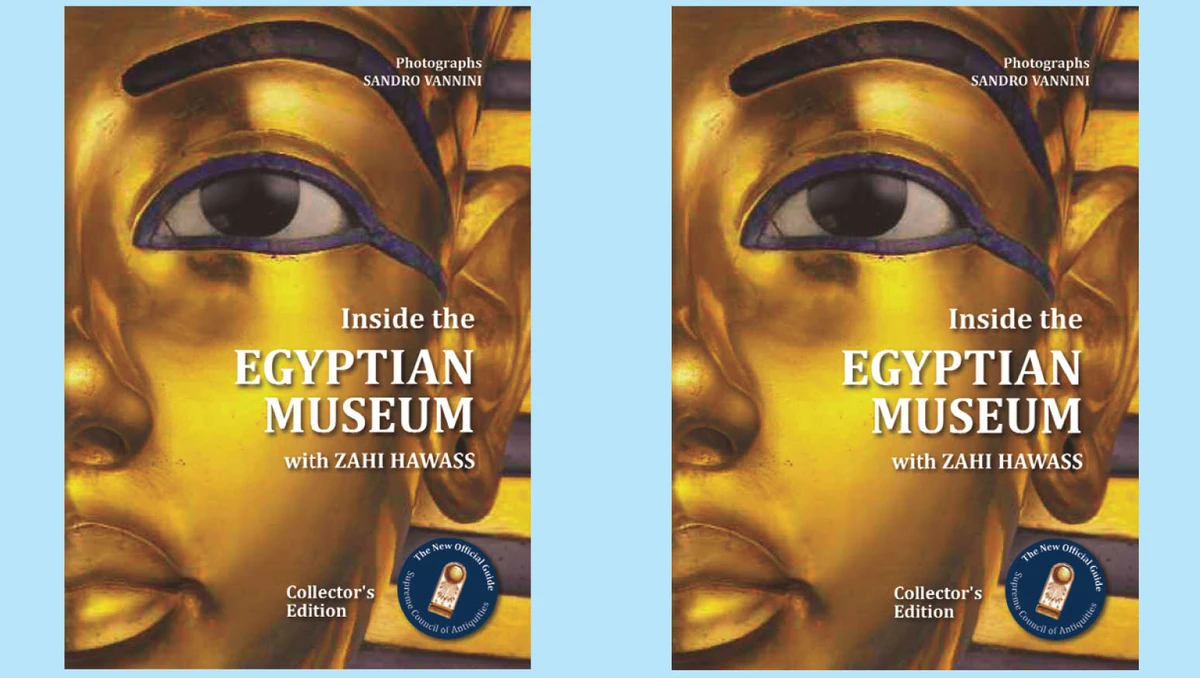
- Inside the Egyptian Museum with Zahi Hawass” is an invitation to visit the Egyptian Museum in Cairo.
- This beautifully illustrated book is told by the charismatic author, Zahi Hawass, who is a world-renowned archaeologist, Egyptologist and the Secretary-General of the Supreme Council of Antiquities.
The Egyptian Museum, which is located in the heart of Cairo, is one of the most important museums in the world and contains the largest collection of Pharaonic artifacts. Hawass writes in his book that an international competition took place between 1893 and 1895 in order to select an architect to build the new Egyptian Museum.
“This was a very impressive decision for its time. Choosing an architect internationally demonstrated that the Egyptian monuments were not restricted to the people of Egypt, but they belonged to the entire world,” he writes.
French architect, Marcel Dourgnon, a French architect, won the competition after he was chosen out of eighty-seven architectural proposals. The Egyptian Museum officially opened its doors to the public on Nov. 15, 1902. Dourgon’s design of the exterior of the Egyptian Museum reflects the chronological divisions such as the Pharaonic, Greco-Roman, Coptic and Islamic phases of Egyptian history.
The museum consists of two floors: The ground floor and first floor. The ground floor is filled with exhibits from the Predynastic Period and Early Dynastic Period (Prehistoric Period to 2686 B.C.) up to the Roman Period (30 B.C. to 395 A.D.). Many tourists may not know this, but the ground floor hosts a replica of the original Rosetta Stone, which is presently in the British Museum. Discovered by the French in 1799 in Rosetta, the Rosetta Stone bears inscriptions in two languages and three scripts: demotic, hieroglyphic and Greek. It was Champollion who gave birth to Egyptology. In 1822, he gave a speech at the Sorbonne announcing that he had deciphered the inscriptions and was able to read the ancient Egyptian language whose meaning had been lost in time.
The first floor contains the Royal Mummies, Treasures of Tanis, Tutankhamun Rooms, Jewelry Room and the stunning Faiyum Portraits. The tour of the upper floor of the Egyptian Museum starts at the top of the staircase with two rooms exhibiting the Royal Mummies. Since mummification is a very fascinating and complicated procedure, many tourists head straight to see them.
Mummification in Egypt originated in the Predynastic Period (before 3,000 B.C.), but the mummification techniques reached their highest level in the New Kingdom during 1550 B.C. to 1069 B.C. During the mummification procedure, all internal organs, including the brain, were removed from the body. Only the heart would remain since it was considered to be the center of intelligence and feeling, and it was believed that the deceased would need it in the afterlife. The body would then be dried in natron (mixture of salt) for seventy days. Finally, the body would get stuffed and wrapped in linen and covered in resins to keep its shape and prevent its decomposition.
Hawass is known for his relentless efforts to bring back to Egypt some of its national treasures, which can be seen in some of Europe’s most famous museums. He has voiced his desire to repatriate some of Egypt’s iconic pieces on television through the written press and even this guided tour gives him the opportunity to reiterate his lifelong concern.
For instance, he discusses what happened to the Mummy of Ramesses II, the most famous king from ancient Egypt, after he was sent to Paris to be studied under President Sadat’s rule.
“It is a shame that the people there decided to keep a sample of the mummy’s hair without asking for permission. The Egyptians scholars, who accompanied the expedition, did not notice that this had happened until the son of one of the doctors tried to sell it on the Internet. As soon as we discovered this, we brought the hair back to Cairo,” he explains.
Hawass is a big fan of the most precious and popular collection: the Tutankhamun Collection. “It is one that will certainly capture your heart,” he writes. It is interesting to note that Tutankhamun’s tomb would not have been discovered on Nov. 4, 1922 had it not been for a fourteen-year-old boy removing sand in order to place a large vessel of water. While he was digging with his hands to get rid of the sand, the boy found a step and immediately informed the Inspector of Antiquities in Upper Egypt at the time, Howard Carter who had been searching for Tutankhamun’s tomb. Carter started to excavate until he found the entrance to the tomb and sent a telegram to his benefactor, Lord Carnarvon who was financing his research. Carter announced that a great discovery had been made and waited for Lord Carnarvon’s arrival to Egypt on Nov. 23 to open the sealed tomb. When Carter finally opened the tomb, he described the items inside as “wonderful things.”
Among those wonderful things was a precious Golden Mask, which was made from 11kg of solid gold and semiprecious stones: “It looks so alive,” writes Hawass. He explains that when Carter found the mask, he immediately tried to remove it, but to no avail, because the resins used during the mummification process had turned into a solid glue pasting the mask to the body. Carter finally decided to remove the mask with some tools, but ended up by damaging the mummy and breaking it into eighteen pieces.
“Tutankhamun died at the age of 19 and there has been discussion over the years relating to why he died so young,” explains Hawass. It was first argued that the hole, which was visible in the back of the king’s head, is evidence that Tutankhamun had been murdered. However, after analysis of the body, they found that the opening had been made for the insertion of a liquid related to the mummification process.
“Recently, after our DNA and CT-scan studies, we made two important discoveries: Tutankhamun’s left leg showed deformities… The second major discovery was that Tutankhamun suffered from severe malaria and this was probably the main cause of his death.”
Chosen by Time magazine in 2006 as one of the world’s 100 most influential people, Hawass also received an Emmy Award for his television work. Since he was appointed Head of the Antiquities Service, he has overseen some groundbreaking improvements in the Egyptian Museum:
“We have opened the first DNA laboratory in the world intended purely for the study of mummies… a new, five-star restaurant and cafeteria will also be found here. We are currently in discussions to open the museum until ten in the evening so that people will have more time to visit.”
Hawass also plans to build a special museum to display the stunning Faiyum portraits. With colors so beautiful and realistic, it is difficult to believe that they were painted during the first century A.D.
The Egyptian Museum comes to life with Hawass’ expert explanations and colorful anecdotes. In this guided tour, he talks about his favorite objects and gives us the opportunity to enjoy an effortless visit of one of the world’s most important museums.
Book Info: