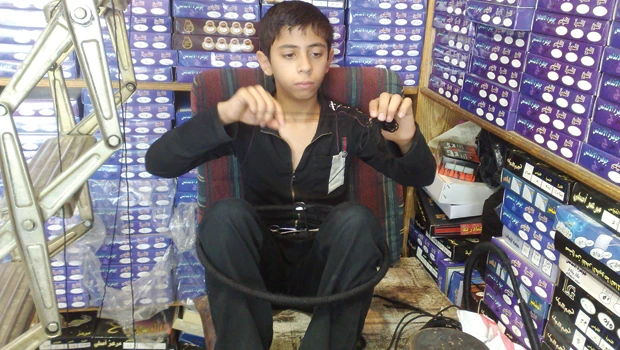
- <strong>Syrian boy masters the art of igal making</strong><br />Taha Samir, a Syrian boy in his late teens, has mastered the art of igal making as he grew up amid white cotton, black sheep wool thread, silk and other raw materials in his father’s shop, “Jawharat Al-Andalus Li Tafseel Il Igal” (The Andalus Gem for Customizing Igals), in Jeddah’s Makarona Street.
The igal is a black rope-like cord used to secure the ghutra — the traditional male headdress — in place.
“Igal making is a passion of mine,” says Samir. “Since my early childhood, I would accompany my father every day to his shop and watch the deft movement of his fingers, wondering if I would ever become a skilled igal maker like him.”
When asked about his unforgettable childhood experiences in igal making, Samir said it was when he received an order from a customer to make a gold braided igal.
“I was confused at first as my father was away, but the customer could not wait until my father’s return. An elderly acquaintance told me where I could buy gold and silver threads, and I finished the work quickly. The customer was so pleased with my work that he paid me double the normal price,” says Samir.
Samir loves making igals to the point that he can’t imagine himself doing anything else. “At times I feel like quitting the family trade in order to look for some other lucrative business, but I cannot do it since I am sentimentally attached to this trade,” he says.
Customers constantly commend his work even though he recollects his father telling him that he would never be a skilled igal maker. “My patience and practice of sitting close to him and watching the movement of his hands while other boys were playing in the streets made me a master in the art,” he says.
The most common materials used to make igals are white cotton, wool, silk, nylon and thread, which is imported from Germany and Syria. The white cotton is stretched to the shape of a rope and then silken, or woolen threads, are woven into it. The equipment used to produce it includes: A special device to wind the threads, a wooden hammer to beat the thread, measuring scales and cutting devices. Furthermore, the fine edges of the wool are sometimes burned carefully and then polished to suit customer taste.
“You can hear the sound of a hammer and other devices even if you pass by our workshop past midnight,” says Samir.
Igals are made in different styles and sizes depending on the size of the person’s head. That is why many people bring their children along so that they can pick the right size for them. The inner white cotton determines the size of the igal, which ranges between 44cms and 90cms. Therefore, the price of a medium type varies from SR50 to SR70 depending on its size and the materials used to produce it.
The varieties of popular igals in local markets are mostly: Marghar, woolen, silken encrusted with pearls, velvet and Al-Shaftah. The Marghar, which is generally preferred by the older generation, is distinct with thick threads; while the woolen, silken and velvety igals are made of very fine thread. Al-Shafta is made of thick and thin threads evenly distributed.
Al-Faysali igal is one of the most expensive varieties. Apart from men, women also like it and use it as a waistband. Because it is made from natural silk with golden embroidery, prices start from SR6,000.
Samir advises customers to make sure you get your money’s worth when buying an igal since there are many imitation products in the market, he says.