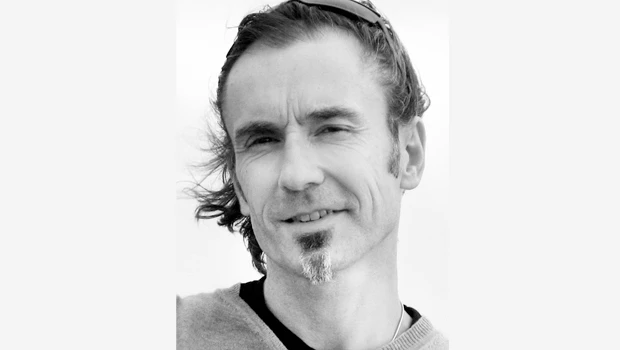
- Michael Banks is photographer who has transcended the medium of photography into highly graphical abstract pieces of art.
- His work is currently on display at DNA boutique in Riyadh, until the end of June.
“For me, photography is art. I just happen to use a camera to make my art, as opposed to a brush and oils,” explains the photo-artist.
According to Banks, when photography was invented around 175 years ago, it freed up the medium of paintings to go abstract, as painting was no longer the sole mode of capturing the world.
“I believe very fervently that we are now in the same position with photography,” he explains. “We have plenty of technologies available, from camera phones to DVD cameras, to show our ‘seen world.’ My personal vision is to make photography fly, to explore its potential fully as an abstract art form, and to push to the limits what you can create artistically with a camera.”
Arab News got the chance to catch up with the innovative photographer and ask him some questions on his abstract-photo art and his love for the Middle East.
Actually, I studied my MA in Fine Art in Florence at the Academia de Belle Arte. I thought I was going to be a painter, but during my incredible time in Florence — which included Vespas, gelaterias and picnics in the Tuscan countryside — someone who was leaving the country gave me a camera. At first, I looked at it like an alien machine, but I went out and used it, and almost instinctively, shot abstract compositions. I was never interested in the “history of photography” because I didn’t really know about it, and I’ve never been interested in doing anything that’s been done before.
I have always been motivated by my own personal mantra: “If it has been done before, don’t do it again!” This has led me down a fairly solitary road — I never read books about photographers, or hang out with photographers — which was contrary to my artistic vision of Hemingway hanging out with his writer friends, which I always thought I’d do in the corresponding photography world. Instead, everything I do comes from a very personal vision, and if I have a “political agenda”, it is to free photography from the anachronistic shackles of representation.
Your work can often be found in spaces with more than one function, such as the DNA boutique. Do you prefer these spaces to more conventional ones?
These environments will feature my artwork all year round, and I enjoy that perpetual presence of my artwork.
I exhibit often in “pure” Fine Art galleries, where the context is largely for the benefit of private collectors, or art institutions, which both acquire my work. Furthermore, a show in a fine art gallery lasts a month; I’m interested in the other contexts in which my artwork will be viewed. I work a lot with interior designers and architects and my photo-art can be found in hotels, corporate spaces and private houses.
DNA Riyadh is a great space, a pioneering space where the East meets the West and the contemporary meets the classic. It is eclectic and avant-garde, never complacent, and always creating a new future. For those reasons, it is a perfect philosophical fit with my photo-art.
The new exhibit will feature new abstract photo-art, all created in the last year, with some revolutionary pieces of Neo-Baroque furniture that feature my photo-art as an integral part of their design. The concept of the show is all about showing the potential of photography — going beyond what we’ve seen a 1,000 times before, such as portraiture, landscape, spaces and objects. Instead, it is a way for me to externalize what is going on in my head and to liberate photography from its burden of representation.
I’m inspired by the world in general and all the random moments of visual beauty which are available for us to see everyday.
It usually starts with a quiet thought — shapes, forms and compositions — appearing in my head. Then, I try and articulate those ideas using the camera as my paintbrush. For me, photography is “painting with light,” which is the actual definition of photography. I use computer manipulation when necessary to complete my vision, but everything starts with my camera.
The best part is the finished image — sometimes it takes 1/125th of a second, sometimes weeks. There is no worst part: I adore what I do.
I’ve had a long connection with the Middle East — my parents worked in Sharjah, Dubai and Abu Dhabi in the early 1970s. As a result, I spent many holidays there when it was totally undeveloped. I’ve always felt comfortable in Arabic culture and geography.
Empty places with lots of sand dunes where I can think objectively about the amazing world in which we live in.
The Middle East is a highly receptive zone to art in general and has a rich tradition of its own art. I find it a very democratic, receptive and embracing place for all kinds of new forms: Architecture, music, fashion, design or art.
I’d like to have a solo show in a gallery in New York. And I’d love to work with a fashion designer to do a range of clothes incorporating my images.
I have a lot of commercial projects to service, such as hotels, corporate spaces and private houses. So I will continue to be busy. I’m exhibiting at a prestigious art foundation in Barcelona and need to plan that. I’m also looking to expand the product areas in which I can use my photo-art, such as furniture. I’ve also just completed a range of rugs based on my photo-art, which I will be launching very soon.