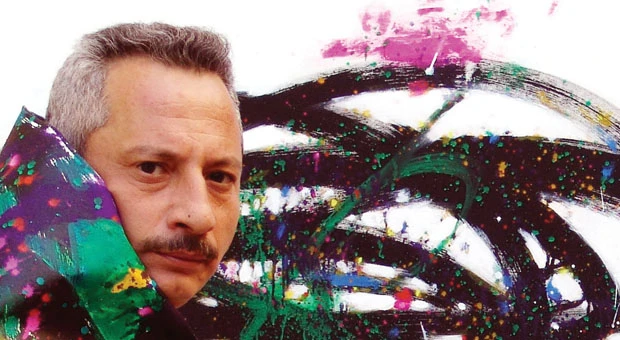
- Dia Al-Hamwy is unlike any other artist.
- His paintings reflect his life: An endless search for beauty captured on canvas.
His latest exhibition in Riyadh is still etched in people’s minds. Ohoud Al-Najran should know as she set up a show of his work in her Riyadh gallery. She still recalls how the exhibition caused a stir in the art scene on the night of the opening.
“Al-Hamwy’s work is a breath of fresh air. His paintings give us the feeling that he is enjoying what he is doing,” says Al-Najran. “The bold strokes and vivid colors evoke happiness and exuberance.”
After completing his studies at the Faculty of Agriculture more than two decades ago, Al-Hamwy decided to become a painter, and he has been painting ever since. In fact, he still works from his atelier in Aleppo, Syria. Neither time has weakened the strength of those strokes nor have the colors lost their intensity in his paintings.
“I threw myself in the deep sea of colors,” says Al-Hamwy. “Now, more than 20 years have passed and I am still trying to seduce the whiteness of the canvas, tempting it as it tempts me.”
He paints like a poet, trying to understand the world through pictorial compositions. He expresses his emotions, frustrations and feeling of loss and confusion through colors and shapes. As a result, he dabbles with the intangible and the unspeakable. His art is an expression both of his visions and love for life.
“Everything in our existence is a reason for happiness: The singing of a bird, a shadow on the pavement, the extraordinary red color of the poppies and the rain in autumn, kids on their way to school each morning, a dirty wall and a clean one, my friend playing the lute in our evening gatherings, the buzz of a fly in the silence of an afternoon, the noise of swallows at dusk and the passing clouds,” he says.
Al-Hamwy believes that art should not be evaluated and thus stays away from art critics and judging committees. “Art doesn’t need a prescription and an ISO certificate,” he says.
His approach to painting can be compared to the solitary, genial and fascinating Daniel Brush, a painter, sculptor and jeweler. Brush isolates himself in his New York loft just like Al-Hamwy cuts off his links with the outside world as soon as he enters his atelier in Aleppo. Both artists search for that inner and primeval artistic expression of a thought, an emotion or an image.
When I asked Al-Hamwy about the subjects of his latest paintings, he replied immediately with a question:
“What is the subject? There is no subject in painting but painting itself, and the subject is only a pretext for the artwork and not its goal. It does not matter whether a painting represents a bird, a woman’s eyes, a landscape, graffiti or a pool of colors. What is important is that all the subjects represent the artist’s vision of the beauty of life.”
Al-Hamwy’s artwork is an ode to life and a symphony of colors and movement. Some works exude an overwhelming power that portrays his feelings of confusion and uneasiness.
Furthermore, he is able to skillfully make his subjects transform into different objects so his audience is left contemplating what the subject really is supposed to be.
For instance, in a painting depicting a field of poppies, the viewer is surreptitiously brought into the midst of this sea of poppies. The quivering petals of the delicate poppies suddenly seem like fragile wings of a butterfly. The field then appears to be swirling with butterflies dangling on stems! By taking another look, however, the stems disappear in the background’s medley of lines. The butterflies are about to fly out into a sea of blue, hardly disturbed by the presence of a bird swimming — or is it a fish flying in the air?
Another painting shows a torrent of water streaming down in what appears to be a waterfall. The water flows sideways with birds flying by. A closer look shows that one bird is flying out of the water. However, is that really a bird or could it be dolphin or a swarm of flying fish?
Whenever one looks at any of Al-Hamwy’s paintings, one is beset with questions. This imaginary dialogue corresponds to his wish of getting the viewer involved and aware of his message “that every person can be himself and the world is a better place to live in”.
Al-Hamwy’s aesthetic choices might surprise, but the value of his work lies in his ability to strike some universal chord and appeal to human emotions, beliefs or ideas through the senses. To understand him you must first understand his work, embrace his vision and share his dream:
“I want to offer the world the constant vision of beauty dancing in front of my eyes,” he says.
For more information, contact Dia Al-Hamwy at [email protected].