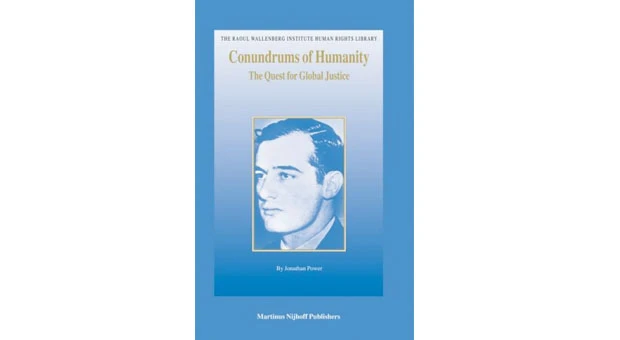
- When Jonathan Power told a friend that the book he was writing was meant to solve eleven of the most formidable contemporary threats to peace and human rights, the friend replied that Power was bidding for the Nobel Peace Prize.
- Now, we have Power’s answers to these problems thanks to his book, “Conundrums of Humanity: The Quest for Global Justice,” and they are extraordinarily impressive.
Although his answers don’t really solve the problems, they do provide an extremely well informed and professional analysis of the issues with which Power has been concerned with throughout an exceptional thirty-year career. He had been mainly working and writing on subjects that western audiences would prefer not to hear about and of which people are reluctant to listen because they don’t really believe there is much that can be done to the following: Making African development succeed, examining the abuse of human rights in third world (and first world) countries, dealing effectively with the consequences of the forced migrations of populations under the pressures of poverty and ethnic or tribal war, restraining the abuse of nuclear arsenals and nuclear proliferation and fixing the inherent inadequacies of the UN.
If they want to try any of these things, then they need this book because it provides sober, comprehensive, intellectual and politically detached analyses of the nature of these problems and the structure of possible solutions.
Power is a geographer and agricultural economist by training and one who empowers ordinary people by passion. He spent the first ten years of his professional life doing community work in Chicago and London slums and taking part in the great racial justice movement in the United States that Martin Luther King led.
He is a writer by profession and a prize-winning documentary-maker by avocation (Venice Film Festival). In 1974, he began writing a newspaper column for the Paris-published International Herald Tribune. The column now goes to an informal syndicate of some forty global newspapers. He has been a consultant to many international commissions and is the Historian of Amnesty International, Associate of the Swedish Transnational Foundation for Peace and Future Research and contributing editor of Prospect.
The questions he addresses in this book include the civilization clash — the urgent current issue; how to diminish the recourse to war at a time when a powerful lobby favors interventionist war meant to install democracy and human rights; the feasible frontiers of human rights promotion; nuclear weapons and their control; the multiple questions of human development in Africa and the implications of China’s economic and political rise.
His discussion of the hysteria generated in the United States when the 9/11 attacks seemed to validate Samuel Huntington’s argument concerning the clash of civilizations. It is particularly valuable in discounting Huntington’s treatment of Islamic civilization as if it were some kind of unitary phenomenon possessing a political identity and purpose.
Power writes: “There has been no clash of civilizations since September 11, merely a clash of one strain of so-called fundamentalism in the US and another strain in parts of the Middle East and Afghanistan.” Accompanied, he might have added, by a phenomenon of mass fear in the United States — certainly politically manipulated — whose sources have yet to be satisfactorily explained psychologically or politically. The American people have never before been terrorized — a condition that continues even now as we witness the widening activities of the Homeland Security Department with respect to visas, travel, communications and collecting private information concerning both Americans and foreigners.
He is very good on immigration with a very sensible discussion of its mixed economic and social consequences and reasonable proposals about how the western countries should deal with a matter that affects the future of them all.
On nuclear proliferation, he splendidly dismisses the dozens of myths and deliberate fictions that surrounded and continue to inflate the nuclear dangers of the cold war. Nuclear weapons actually were an obstacle to war and neither side had any claims on the other that could have justified their use. He deflates the common belief that the Cuban missile crisis came close to nuclear war. It came close to provoking a conventional attack by the US on Cuban missile bases and by Moscow on Turkish missile sites, but nowhere near to causing a Soviet-American nuclear exchange.
He makes another valuable and neglected point about the causes of wars, in which he argues: historically have mostly been trivial and in the aftermath, often seemed incomprehensible. Obviously this is true of the First World War; but, while economic and trade issues have frequently been sources of political conflict, they have less often been the causes of war. Historically, issues of prestige, territory or dynastic interest have more often caused wars.
During the last two centuries nationalism and ideology have been responsible for catastrophic wars, but the national causes of the nineteenth century were usually emotional and inflated (as they continue to be), and the great ideological upheavals were inspired by fictions. Millions died over the Marxist-Leninist fiction that “science” was leading humanity to a condition of paradisiacal happiness — a proposition that was simply a secular translation of biblical eschatology. Germans and millions of their victims died in the effort to establish the self-evident and indeed monstrous absurdity of a eugenically purged mankind to rule a thousand-year Reich.
This brings up the one major disagreement I have with Power: his optimism and faith in human goodness. I find much history a discouraging account of human badness. He believes that, ultimately, solutions not only can, but will be found to our problems. “We have no choice but to make positive changes in the way we live.” He believes that peace comes with democracy and that (in spite of George W. Bush’s “democracy crusade”) democracy is rapidly making its way in global society. “Even countries that do not practice it give it lip service.”
G.B. Shaw once said that all progress depends on the unreasonable man. The reasonable man adapts himself to the world as it is, but the unreasonable man is determined to change it. This book is filled with reason, good sense and optimism, and in those respects is (in my disabused view) unreasonable. But, I am much older than Power!
His is a powerful and comprehensive statement of ways to make the world better. He is unreasonably good, as demonstrated by his personal commitment to the developing world, the fortunes of the poor, the defense of human rights and his devotion to the society’s progress. Is that worth the Nobel Prize? I say why not?