
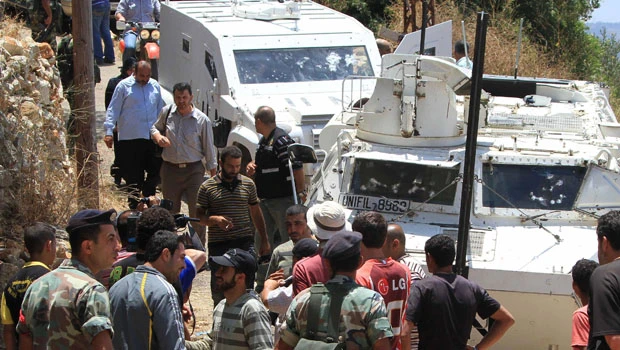
- TULINE, Lebanon: Villagers disarmed a French patrol of UN peacekeepers Saturday after attacking them with sticks, rocks and eggs in south Lebanon, in the latest in a string of such incidents, the Lebanese Army said.
"Residents of the village of Tuline as well as some villagers from nearby Kabrikha attacked the patrol with sticks and threw stones and eggs," a military spokesman said.
"The citizens disarmed the soldiers and briefly took control of their vehicle before the army intervened and made them move away from the patrol," the spokesman said.
"The arms were returned to UNIFIL and the incident is closed," he said, referring to the United Nations Interim Force in Lebanon, which patrols the border region with Israel.
He said the peacekeepers had earlier arrested a young man in Kabrikha who opposed their presence in his village. In Tuline, local residents attacked the patrol, demanding the man be released, the spokesman and witnesses said.
According to an eyewitness, a French soldier suffered a minor eye injury while a young man was seen with a bloody face. Two UN vehicles appeared to have been hit by rocks and eggs.
The official National News Agency said the disturbances broke out after a French patrol hit a car and a motorbike in Kabrikha.
UNIFIL was unavailable on Saturday to comment on the incident.
Hezbollah has urged the peacekeepers in south Lebanon, a stronghold of the group, to stick to their mandate, following a wave of protests by villagers. "UNIFIL should always carry out its role ... in a way so as not to arouse mistrust and worry of citizens as was the case during the latest exercises," Hezbollah's No. 2, Naim Qassem, said in a newspaper interview.
The protests started during a maximum deployment exercise last Tuesday by the UN force charged with overseeing a cease-fire between Israel and Hezbollah, which fought a devastating month-long war in 2006.
Qassem said the peacekeepers "must stick to their mission as prescribed by (UN Security Council) Resolution 1701.” “Then there will be a return to normalcy," said the Hezbollah official.
Resolution 1701, which ended the Hezbollah-Israel war in 2006, expanded the mandate of UNIFIL troops, which was originally formed in 1978 after the outbreak of Lebanon's 1975-1990 civil war.
Commenting on the growing hostility between local residents and the peacekeepers in recent days, UN special coordinator for Lebanon said: "Some of these may have been something spontaneous in the street, but some were clearly organized."
UN Secretary-General Ban Ki-moon said Friday that Israel's allegations that Hezbollah had received Scud missiles from Syria had "resulted in increased tension" in the region. Syria has rejected the missile allegation. Ban's latest report to the UN Security Council on the implementation of Resolution 1701 noted several tense confrontations between UNIFIL peacekeepers and civilians.
Ban's report said there was reason for "doubt on the motives of those (civilians) involved" in some incidents.
Resolution 1701 calls for a stop to arms smuggling and bans all unauthorized weapons between the Litani River and the Blue Line, the UN-monitored border between Israel and Lebanon.
Israel has criticized UNIFIL for not stopping weapons it says are flowing to Hezbollah fighters. The United Nations says that is the responsibility of the Lebanese authorities.