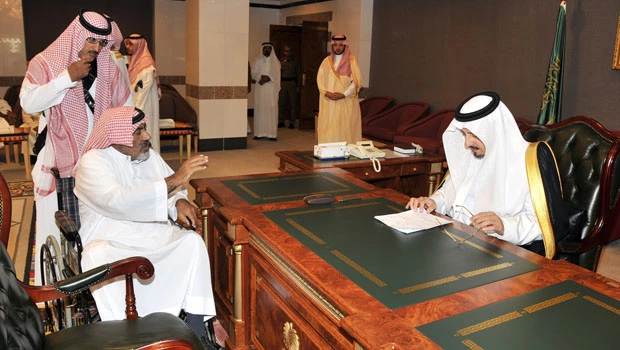
- ABHA: Houthi rebels have never dared to attack Asir region, which shares long borders with neighboring Yemen, the region’s governor, Prince Faisal bin Khaled, told Arab News in an interview.
"Our armed forces and the border guards are very vigilant and will crush any aggressor who dares attack a single inch of our land," he said.
The Houthi rebels were defeated by Saudi Arabia's armed forces when they tried to infiltrate the southern border from Yemen late last year.
Prince Faisal, who was born in 1953, is the son of the late King Khaled. He became governor of Asir in 2006. Before that he was deputy governor.
He said a special exhibition about his father, currently being held in Riyadh, would come to Abha on July 13 and travel to other areas after that.
"The doors of the exhibition will be open to everyone in the region free of charge, particularly students. It reflects the historic achievements of King Khaled and displays a chronology of his rich life," he said.
Asked about the most common problems in the region, Prince Faisal said land encroachments are among the most important issues that he has to deal with almost on a daily basis.
"Asir is a spacious region. It is only natural that some cases of land aggressions take place. These are on the top of the issues that we already have to tackle. I call those who transgress on the lands of others the enemies of development," he said.
The governor said 28 committees have been formed to monitor land encroachment. "These committees are doing their work properly," he said.
Prince Faisal denied that the crime rate in the region was on the rise. "I do not agree with you. During the last two years the crime rate in Asir has gone down by more than 18 percent,” he said.
“Security in all regions of the Kingdom is witnessing development. The success of the Kingdom in crushing those who are deviant is enough proof," he said.
Prince Faisal, who is chairman of the region's investment council, said Asir offers much promise for investments. He said the council has prepared an encyclopedia on investment opportunities in the region in Arabic and English for interested investors.
"We have started the implementation of some projects after studying their feasibility. Others are still under study," he added.
Prince Faisal said Akaba Wadi Dela, a crucial 44 km stretch of road in the southern region that becomes impassable during rains and floods, has now become one of the best roads in the region according to international specifications and standards.
He admitted that many lives were lost in a flooding incident in the Akaba but said it was now safe for anyone to travel through. The Akaba is Asir’s main link with Yemen. It is also a key road connecting the southwest area of the Kingdom to the rest of the country.
On the proposed construction of a seaport in Asir, the governor said a technical and economic team from the Seaports Authority, the governorate, the region’s chamber of commerce and other government departments visited the earmarked site, including the Al-Qamha seaport on the Red Sea, and submitted a report that was forwarded to the authorities concerned.
"We are now waiting for the approval of the project, which will add an economic and developmental depth to Asir," he added.
He said the region is in dire need of a seaport in the light of current development projects throughout the Kingdom.
Prince Faisal, who is also the chairman of the region's tourist development council, said there is no woman tourist guide in the region. "This is within the concerns of the Saudi Commission for Tourism and Antiquities. Whenever the SCTA sees a need for one, we in the region will have no objection," he said.
The governor pointed out that women were effectively participating in all tourism activities in the region. "There are activities which are solely managed and executed by women."
Prince Faisal did not dismiss the possibility of a woman sitting on the council. "We can consider giving seats to women in the council whenever there is an opportunity in the future," he explained.
Asked if the theater in Al-Muftaha is the reason that people are staying away from the area, Prince Faisal said work is currently under way to rehabilitate this historic and beautiful village.
"I do not think the presence of a theater is the reason why citizens and visitors are not going to this cultural village, which is considered one of the most aesthetic areas in the country," he said.
He recalled that many cultural and artistic activities were held in the historic village, the latest of which was the Asir International Art Exhibition.
"The village has a historic palace which is being used as a museum. It also has heritage markets and other places that can attract tourists," he said.
The governor did not agree that there were insufficient services in the eastern part of Al-Bark district, when asked why local residents have been complaining of a lack of sufficient services despite the region's SR8 billion budget.
"The district has a general hospital, a number of health centers, a police station, Civil Defense, Red Crescent and a municipality in addition to other government offices. If there are any shortcomings, we will correct them in the very near future," he asserted, describing the area as one of the most beautiful spots by the Red Sea.
Prince Faisal said this year’s Asir Summer Festival would feature the participation of a number of folklore troupes from the region and outside, in addition to some groups from a number of Arab countries.
"The festival will include religious, cultural, social and entertainment programs designed to attract tourists," he said.
The governor denied claims that singing was prevented during the previous year's festival. "There will be opera numbers at the opening and close of the festival this year," he added.
Asked when the first media forum in the Kingdom — announced two years ago — would be held in Abha, the governor said the event was postponed because the organizing company did not make enough arrangements at the time.
"We are currently working with the company to ensure full preparations and will obtain the necessary licenses and approvals within the next few months. By then we will be able to fix a date for the forum," he said.