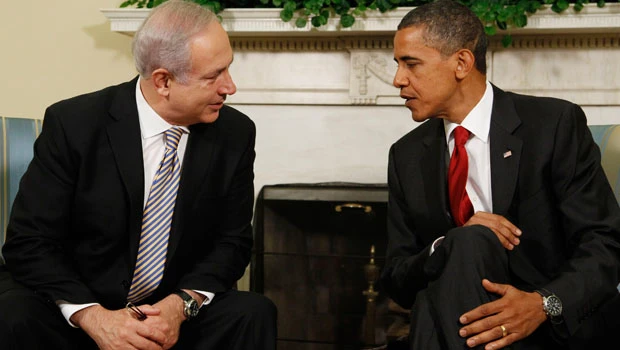
- WASHINGTON: After a series of conflicts over Israel's Gaza blockade and settlement expansion policies sidelined direct peace talks between Palestinians and Israelis, US President Barak Obama and Israeli Prime Minister Benjamin Netanyahu met Tuesday morning at the White House.
After the meeting, Obama said he hoped for direct peace talks to start before the end of September. "I believe that Prime Minister Netanyahu wants peace. I think he's willing to take risks for peace," Obama said, and strongly disputed a question, which suggested the strong bond between Israel and the United States had frayed.
"The fact of the matter is that I've trusted Prime Minister Netanyahu since I met him before I was elected president and have said so both publicly and privately."
The talks went ahead with intense interest surrounding a partial Israeli freeze on settlement building, which is due to expire in September. Obama finessed the issue by saying he hoped progress toward direct talks from indirect US-brokered proximity talks between the parties would render that deadline irrelevant.
"My hope is that once direct talks have begun, well before the moratorium has expired, that will create a climate in which everybody feels a greater investment in success," he said.
Netanyahu warned during the talks that the prime threat facing Israel was Iran's nuclear program, and praised new US sanctions against Tehran. Obama also reassured Netanyahu that his administration had made "no change" to its policy regarding Israel's undeclared nuclear arsenal.
The public show of unity matters for the fragile Middle East peace process and for domestic political consumption on both sides. Members of the Democratic Party are concerned about what a perceived rift could have on the midterm elections, as Republicans attempt to use any perceived rupture with Netanyahu to argue that Obama is insufficiently committed to Israel.
Throughout the US, Republican candidates have been raising Israel as part of a broader critique of Obama's foreign policy, seeking to chip away at national-security-minded independents and Jewish voters who traditionally support Democrats.
When Obama made statements of measured support for Israel after a raid on a Turkish flotilla carrying aid to Gaza last month, Marco Rubio, the Republican candidate in Florida's Senate race, which has a large Jewish community, delivered a speech sharply criticizing Obama's Israel policy.
"There is the emerging sense that this long-standing relationship isn't what it used to be," Rubio said.
Obama was cool toward Netanyahu during their last meeting, leaving the Israeli leader and his aides in the West Wing alone for hours as a subtle rebuke over Israeli settlement policies.
The two were never photographed, which in diplomatic code sent a chilly message.
That encounter followed an announcement by Israel, during a visit to the country by Vice President Biden, of a plan to construct 1,600 Jewish homes in a part of East Jerusalem that Palestinians view as their future capital.
In contrast, hours before Tuesday's session, Israel announced that it was indicting and disciplining three military officers for their actions during the 2009 Gaza military operation.
At the White House, there were pictures of a smiling Netanyahu clasping hands with Obama, and a joint news conference. The tone was expected to show the Israeli public, and pro-Israel Americans, that relations between the allies are back on track.
The two leaders discussed how to diminish tensions between Israel and Turkey. Tensions between these countries are rising after Turkey said it would sever diplomatic relations with Israel unless the country apologizes for its raid on a Turkish aid ship — or accepts an international inquiry into the incident.
The Turkish statement was released just as Netanyahu prepared to meet Obama at the White House. Observers say that Obama pressed the Israeli leader to apologize to defuse tensions.
— With input from agencies