
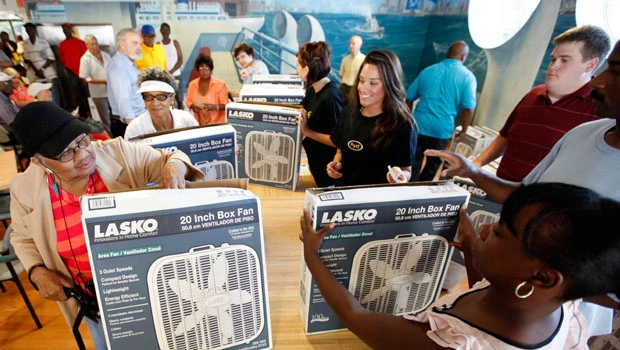
- PHILADELPHIA: The eastern US cooked for another day Wednesday as unrelenting heat again sent thermometers past 100 degrees Fahrenheit (38 Celsius) in urban "heat islands," buckled roads, slowed trains and pushed utilities toward the limit of the electrical grid's capacity.
Philadelphia hit 100 degrees for second straight day, breaking a record of 98 degrees (36.7 Celsius) set in 1999.
Baltimore hit 100 for the third straight day and Newark, New Jersey, hit triple digits for the fourth straight day.
New York's Central Park was at 99 degrees (37 Celsius) at 2 p.m. (1800 GMT) Scattered power outages affected customers up and down the coast and usage approached record levels. In the Washington, D.C., area, nearly 1,000 customers were without power Wednesday, while New Jersey's largest utility, Public Service Electric and amp; Gas, reported about 6,300 customers without power. Consolidated Edison in New York said it was working to restore power to about 6,300 customers, down from outages to 18,700 customers Tuesday.
The heat also forced nursing homes with power problems to evacuate and buckled highways near Albany and in the Philadelphia area. On New York's Long Island, a radio station was distributing free bottled water to day laborers, while human services workers in Pittsburgh were doing the same for the homeless there.
The hot weather is especially dangerous for the elderly, but even the young and fit were having trouble.
The US Naval Academy said four midshipmen who had just completed an obstacle course needed medical attention for possible heat exhaustion after they completed an endurance course that included climbing cargo netting and jumping over logs.
In Middletown, Connecticut, police charged two high school assistant football coaches with reckless endangerment after a player collapsed while running an uphill sprint Tuesday evening.
New York, Philadelphia, Baltimore and other dense, built-up areas are getting hit with the heat in a way their counterparts in suburbs and rural areas aren't. Cities absorb more solar energy during the day and are slower to release it at night.
But it was also hot at the beach.
Transportation officials cut the speed of commuter trains in suburban Washington, D.C., and New York when the tracks got too hot.
Extreme heat can cause welded rails to bend under pressure. Some New Jersey trains were canceled and rail-riders were advised to expect delays.
Meteorologists in some places began calling the current hot stretch a heat wave, defined in the Northeast as three consecutive days of temperatures of 90 degrees (32 Celsius) or above.