
- ATHENS: The Greek government is battling growing discontent over a new round of economic austerity, with fresh strikes, public hostility, and party dissent testing the nation's ability to make it out of its debt crisis.
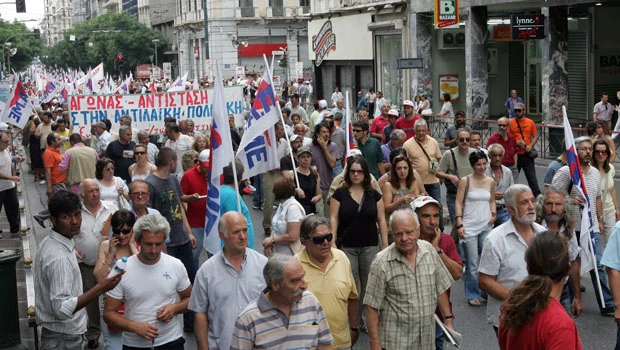
Unions on Thursday staged their sixth general strike this year — halting public transport and services, stopping ferry departures and closing schools, newspapers, courts and public hospitals.
"We will insist in this protest because we are right," said Yiannis Panagopoulos, leader of the GSEE umbrella union which is heading the strike.
Socialist-led unions angrily oppose an overhaul of pension and labor laws, in a confrontation closely watched by other European countries grappling with their own high budget deficits and struggling welfare systems.
More than 2,000 people took part in a central Athens protest march, carrying banners and chanting slogans against the austerity measures and reforms.
The march was peaceful, although previous demonstrations this year have turned violent, with groups of masked anarchists breaking out of the marchers' ranks to clash with riot police.
On May 5, three employees died trapped in a bank set on fire by suspected anarchist rioters. The tragedy shocked Greek public opinion and led to lower participation and more contained violence in later protests.
Several thousand people also gathered in central Athens Thursday for a second protest organized by a Communist Party-affiliated union. Two separate protests were also planned in the northern city of Thessaloniki.
Late Wednesday, Greek lawmakers voted in favor of imposing sweeping pension reforms, scrapping benefits and raising women's retirement age from 60 — and in some cases from 50 — to 65. The new law will also make it cheaper for companies to sack employees.
Socialist dissenters had openly criticized the bill, but yielded to strong party pressure after winning dozens of 11th-hour amendments, most slowing down the changes.
A late pledge also came from Prime Minister George Papandreou to eventually reverse some pension cuts.
"When our economy is back on its feet, and growth returns, we will be able to improve pensions and offer better services to workers and pensioners. That is our commitment," Papandreou told parliament before the vote.
Some changes could still be undone when legislators vote again Thursday on individual articles of the pension reform.
"I expressed my very strong reservations to a number of articles," said Panayiotis Kouroumplis, a Socialist member of parliament.
"Criticism can be helpful ... We are not living under colonial rule." Despite cutting salaries and raising taxes, Papandreou remained popular for months during the country's major financial crisis, triggered by ballooning deficits and a national debt of more than ¤300 billion ($377 billion).
But recent surveys point to a slump for Papandreou's Socialists, after Greece dodged the immediate threat of bankruptcy and began imposing painful longer-term reforms while the country sank deeper into recession.
The reforms were agreed in exchange for ¤110 billion in bailout loans from the European Union and International Monetary Fund.
A weekend poll for the Athens daily To Vima showed support for the Socialists at 23.4 percent, compared with 43.9 percent of the popular vote for the party in general elections last October. The Kapa Research survey of 1,002 adults on June 30 and July 1 had a margin of error of plus or minus 2.5 percent.
Greek fiscal reforms are considered the most ambitious among EU countries like Britain and Spain that are imposing budget cuts.
The EU says the Greek fiscal measures are "broadly on track" but warned in a report Wednesday that unemployment is likely to worsen after hitting a 10-year high of 12.1 percent in February.
The data has done little for party morale, as Cabinet ministers scramble to avoid bearing the brunt of drastic spending cuts. Papandreou has already expelled three deputies who failed to support austerity measures in parliament.
Transport Minister Dimitris Reppas, in charge of several loss-making public transport companies, lashed out at the treasury this week, demanding that more be done to curb tax evasion.
"We should not point our finger at workers," Reppas said. "There is wealth in this country that remains untaxed, and those with high incomes who should contribute more. This effort must be much more effective." Ferries to Greek islands and train services have also been canceled due to Thursday's strike, and flights will be grounded between 0700 and 1100 GMT.